Rota and Lucca have been recording music together, sporadically, for many, many years. By day, mild-mannered Eric Sirota and the effusive Ben Schwartz are normal, everyday citizens going about their days: Raising toddlers, going to work, and buying groceries. But on occasion, they combine their collective forces to build something larger than the sum of their rather modest individual parts. They assemble to become indie rap’s preeminent crime-fighting duo, The Nocturnals. (Well – maybe – they are the second-most preeminent duo if I’m being honest. Shout out Run The Jewels.)
Rota does words. Lucca makes beats. When they combine, they’re an unstoppable force akin to Batman & Robin, Rocket & Groot, or Cap & Bucky. Just don’t ask me who the sidekick is; they’re both crucially important. Their elements fused is what makes The Nocturnals – specifically their most recent album Prescriptions – so very thrilling. I sat down with them roughly a thousand years ago (truly sorry for the delay, guys!) to chat with them about how they create their unique brand of friendly neighbourhood hip-hop.
[Ed. Note: The following interview has been lightly edited for clarity, but is otherwise the full conversation between Black Rainbow Collective, Rota, and Lucca.]
Black Rainbow Collective: Guys, the Prescriptions album is fantastic. I fell in love with it as soon as I heard it. The first thing I heard was that “Woah Now.” song on SubmitHub, and it just grabbed me instantly. Your creative process is something that I’m interested in. I think it sounds like that record was made around the pandemic; almost all of it, is that right?
Rota: Yeah. All the writing, I think.
BRC: I wondered how you guys match up lyrics to the music and vice versa, or how that process goes?
Lucca: Usually I just will text and [Rota] will be like, “Yeah, I’ve been writing a lot”. I’ll be like, “Good, I have 800 beats,” and then I’ll just send some beats. I love working with Rota because honestly, I could send him one beat and the next day he’ll be like, “Here’s three different things I wrote to the beat, or things I wrote before that which I put to the beat.” So we actually just started this process again a couple weeks ago for a new project and you know – same idea – I just sent like twenty something beats, and then he just starts sending me back stuff, and we go from there. In the early days, he would record things and then I would just switch all the beats at the end. But we’ve gotten away from that now; it’s more collaborative.
R: It seems like Ben has infinite, high quality beats, like a million beats. Once in a while – and it’s harder now with kids and everything, with our schedules – but once in a while, a few times a year, I’ll also go over to Ben’s house and run through beats. But it’s funny because there’s just hundreds, and they all have these different naming organization functions where it’ll be a beat where every color you could imagine is the name. And then Ben runs out of colors. And then it’s a combination of two colors.
L: It is!
R: So I think one thing is, we haven’t ever consistently had a system where I write to the beat or I match pre-written lyrics to the beat. It’s always some of both. Sometimes I’ll write to a beat, and then it will actually sound good to that beat, but it goes well with another beat. So that’s always been like a combination of processes, I think.
L: Yeah. And I mean, for the most part we do it, you know, Postal Service style: Sending stuff back and forth. Because it is also pretty rare that I’ll just send him a beat and he’ll write on it, and then I won’t want to change the beat. Because like he said, when I make beats, I make so many. And I have all these colour systems to rank them and organize them and stuff. But truly, I don’t really understand what it’s about until someone does something with it, you know what I mean? So when I hear from him and, you know – I’m just thinking about new things he sent me recently – I’m like, “Okay, I need to add this part because I understand the feeling there.” So yeah, it’s a back and forth. And then it’s always that hard thing of like, when is it done?
L: You know, we kind of get to a point where I’m like, “Okay, we just have to stop now” or “It’s good enough.” It’s never going to be, you know, perfect.
BRC: Like, how that last stroke can ruin a painting, or whatever. You know, when do you stop? When is something really finished?
R: To piggyback off what Ben was saying, there’s a bit of a process where it’s like, right, Ben will send me a beat. I’ll record rough vocals, I’ll send back the rough vocals, Ben will amend the beats and then send it to me, and I’ll re-record it. It’s pretty collaborative. I think we both have trouble being like, “This is finished.” I feel like I heard the saying, “Artists don’t finish, they just stop”. And I think that’s pretty true.
BRC: Yeah. As soon as you said that I thought that’s a common theme. And I think – obviously depending on the artist – you can handle it differently. Jack White – for example – will book a studio – well, not now, as he has his own studios – but he’ll go into a studio and make a record in a week. Or Kanye will put an album out and tinker with it after it’s out.
So obviously there’s like massive spectrum – that level of fucking with things is a spectrum, right – which is interesting. And actually the way you guys work, it sounds a lot like a typical band, obviously. Because you’re a hip-hop duo and there’s so few of you, I thought it would be a different answer to what I might be used to, or what I would expect to hear from talking to bands or other artists who make more traditional music with collaborative songwriting and instruments. You know, traditional band setups. But actually the way you guys work sounds quite similar. I love The Postal Service reference. I love that band.
L: I figure we’re all of the age where we can appreciate that reference, maybe.
BRC: Yeah. Oh man, I love that record, it’s tremendous. Ben, you mentioned, you don’t really know where things are going – that you’re working on – until somebody else works on it or contributes to it, or maybe adds their input. It steers you in a direction, maybe?
L: I mean, to a large extent, yeah. But I think obviously – you know – everyone talks about vibe. “It’s all vibe. I’m here for the vibe.” But really, like when I’m making a beat, it is just like I just have some kind of feeling about it. And it’s very rare that I’m like, “What should I do?” It’s just like, I just do it.
BRC: You just go.
L: Yeah, yeah. And so I definitely have kind of a sense of what I’m doing, but at the same time, like I’ve always made beats that are in pretty much every tempo range and I’ve never been like, “I gotta make it around 91.” Like, 91 bpm is probably my most common tempo, but I make stuff from the sixties to double time too, you know what I mean? And so anyway, that is all to say, it has some meaning, it has a feel to it. But then when you put lyrics to it, it takes it to a different level.
BRC: Sure.
L: Because he’s great at picking things that, you know, like it’s you. It just feels right with the lyrics. And I mean, I think we’ve gotten better at working together. You know, we started our first band when we were like eight years old or something like that. And we’ve been making music for like thirty years or whatever. And we finally, I think, figured out sort of how to do it. So, that’s good. Thirty more years and we’ll be number one single all over the radio, which will obviously still exist in thirty years.
BRC: That’ll be good. One thing I wanted to touch on is, you mentioned about people adding things to your beats. Does that mean you produce for other people as well as the work you guys do together, or what? How does that work?
L: Honestly, yes and no. In the past, there’s been a couple other artists who have worked. One of the main ones unfortunately passed away this year. But if you know emcees, I’ve got lots of beats. So the answer is I wish I was better at sharing them because I love working with Rota, but at the same time, you know, different voices sound better on different things. We have a couple other mutual friends. There’s a guy in Chicago named Young General who’s a friend of ours who I sent some beats to. But yeah, besides my friend who passed away, as I mentioned, Rota and I just work very well together. I can send him something and then he’ll text me and then three days later I’ll be like, “Sorry.” He doesn’t take it personally or anything. It just works well together. Again, I wish I was more of the person to put my stuff out there, because I would like to work with different people.
R: I lived in Champaign, Illinois, for a few years. and I was in a hip-hop group there. We used a bunch of Lucca’s beats, and there were some other folks in the scene that used a beat or two of Lucca’s too.
BRC: I have somebody I might like to put you in touch with actually, Ben, if you’re looking for people to rap on your beats. Another guy from Black Rainbow Collective, Yesh Yoko. He’s based in Philadelphia, but he does beats and raps. Maybe there’ll be options for that. I don’t know, but I’ll send you the details afterwards.
L: Oh OK, cool. Thank you.
BRC: You mentioned Champaign. I ask everybody that I interview about where they’re from, because obviously, when you live in a space or a scene or an environment, it’s just your nature and you’re so familiar with it, especially if you’ve been there for a long time. But a lot of people don’t have that perspective, you know. I was talking to MxDicey on here a while ago about the scene in Auckland, New Zealand, because who knows what the scene looks like in Auckland? So if you could, I would appreciate it if you could elaborate a little bit on what it looks like in Illinois. I don’t think any people generally know anything past Chicago when it comes to Illinois. I don’t really know what else Illinois has to offer.
R: We both grew up in Evanston, a suburb just outside of Chicago, and I think we’ve both spent most of our adult lives in Chicago. I mean, I lived in Champaign for four and a half years. And the music scene there was a big part of my life. It’s a really, really great music scene down there. And I think that people only associate Champaign with the college, and there’s a lot of good music coming out of the college. There’s actually a guy we’re both friends with who goes by The Letter L, who’s a professor of hip-hop studies at Illinois, and I think we’ve both worked with him at some point. There’s a lot of really good artists. There’s an artist named Mo Pecci. There’s an artist named Black Mage. There’s a lot of really high quality hip-hop artists there, and kind of like a vibrant music scene that I think does get overlooked in that way. Outside of Chicago, I feel like I don’t have that much insight. Like I got to know a bunch of central Illinois rappers just being down there. I don’t know if there’s… Well, the only example is Ludacris. He went to grammar school in Champaign, so he’s the only prominent rapper [from there], I think.
L: LUDA!
R: I mean, yeah. And then obviously Chicago has a pretty tremendous scene.
L: There’s so much going on in Chicago and so many people, it’s hard to say. If there’s one scene, there’s probably dozens. You know what I mean? There’s a venue called Subterranean, [and these] venues end up with their own kind of little cultures around them. But these days with things as fragmented as they are, there’s a scene in Chicago or wherever you are. And then there’s the Internet scene, which can be if you’re in London or if you’re in Chicago or Auckland or wherever. So I don’t know, I’m not sure. I wonder how connected we are to the scene, so to speak. I wouldn’t say that the style of music that we make is representative of a scene at all. And that’s one thing that I think makes it interesting. Like I would say the style of my beats is somewhat diverse. And I think the style of Rota’s lyrics and his style of rapping and also singing – at times – is pretty diverse. So in that way, we’re not part of any scene at all, I would say.
BRC: Yeah, I think that sounds like a fair assessment. I know that you are also a graphic designer, so I wanted to ask you a little bit about that as well, just because that’s another artistic avenue that you guys – or you specifically [Lucca] are involved in. Is that something you do professionally, or as a side thing, or what?
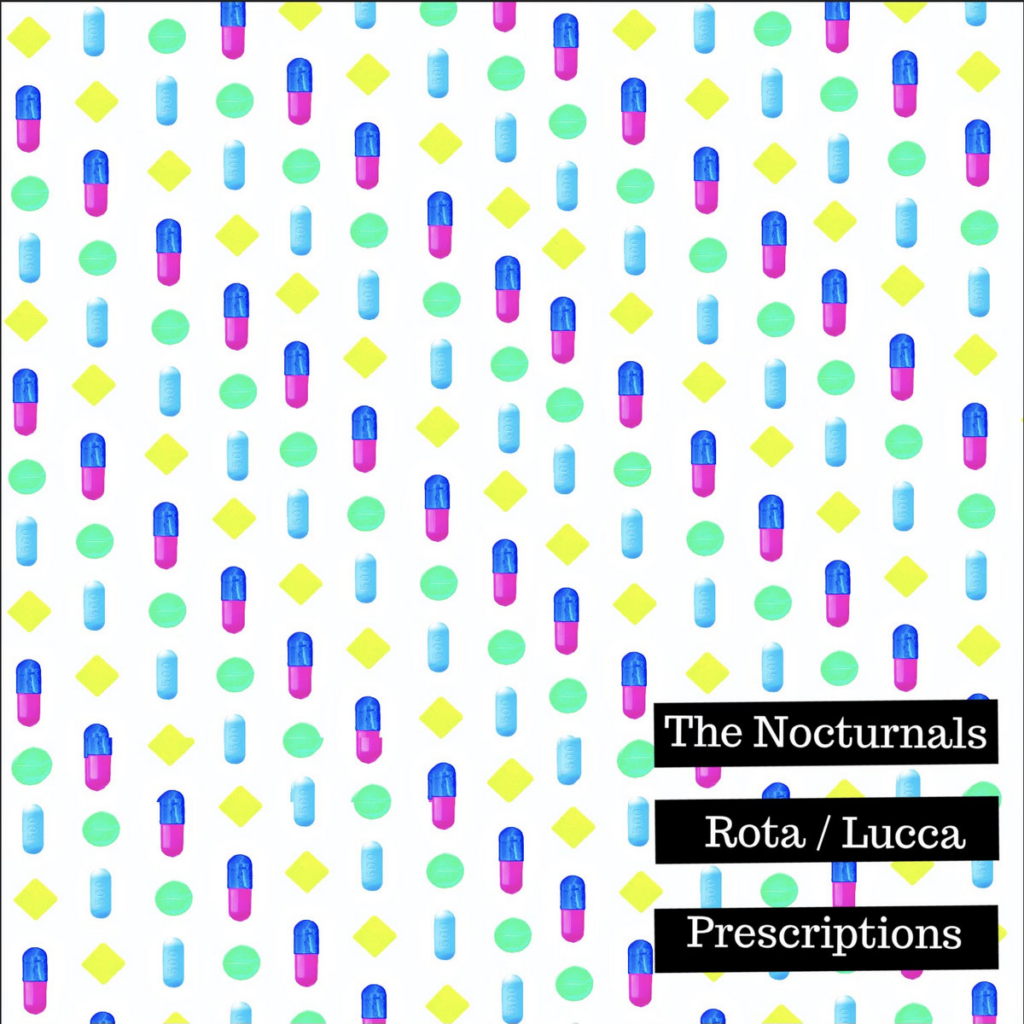
L: I’d say it’s something I’ve done even longer than doing music, which I’ve been doing, you know, for a couple of decades. I mean, I’ve always done art – drawing and painting and stuff – and then graphic design for thirty years, probably. I love doing calligraphy. It’s something I’ve made some money off in the past here and there, but yeah, it’s mostly just a side-hustle. With having a son, I can draw things for him and it’s just another form of expression. And like I said, once I have something that has some meaning behind it, it’s easy to create art around that idea. And I love it. It’s fun. Like, Rota was like “Prescriptions” – we always send names back and forth for names for things, you know, ‘til we end up agreeing – and once that came in, I just started thinking about, you know, it’s not like a brilliant take on the idea…
R: It’s a cool cover, it’s a cool cover.
BRC: It is a cool cover.
L: Well, thank you, I appreciate that. I always loved patterns and you know, pop art, modern art, anyway. So yeah, it’s something I love.
BRC: I definitely got the pop art vibe from it. It also reminded me of… Do you know the group Spiritualized? They have an album that’s – like – the art is based on blister packs for pills? [Ed. note: Ladies And Gentlemen We Are Floating In Space.] It reminds me of that as well. And Damien Hirst had loads of pill stuff as well. It reminded me of that a little bit. It’s good.
L: I did it all in Photoshop, but I was thinking it would be cool to actually stage it and photograph it. It reminds me of one of my favorite graphic designers, Robert Brownjohn, who’s famous for doing the GoldenEye titles for the James Bond movie. But he also did this Rolling Stones album cover where it’s like an actual cake that he made on a record player and he took a photo. It’s so cool.
BRC: Let It Bleed.
L: Yeah, exactly. That’s right. So there you go.
BRC: You mentioned calligraphy earlier. The [art for] the Nocturnals’ 2020 single, did you make that?
L: I drew that.
BRC: That’s beautiful. That’s lovely.
L: Thank you very much.
BRC: And Rota, by day you are a lawyer. Do we want to talk about that? Or do you want to skip over it?
R: If it’s interesting to you, I’m happy to talk about it.
BRC: I’m interested in it. I just know that a while ago you were a little bit trepidatious about how much you wanted to talk about.
R: Well, you know, the political climate. Because I teach it at Northwestern Pritzker Law School. So, I run a clinic called the Tenant Advocacy Clinic. Law students represent real clients – like mostly people facing eviction or tenant associations, subsidized buildings who are trying to live in better building conditions – and the students represent them for class credit. I supervise the students and also teach a once a week seminar that accompanies that supervision. I think at times I’ve been hesitant to talk about it, but I’m happy to talk about it.
BRC: You talk about as much as you want. Obviously it bleeds into the work and the book that I covered, and so to me it feels relevant. But you know, you approach it as much as want, as much as you feel comfortable with.
R: I guess I’ll just say there’s been times where the course… Under the current administration, the environment for universities is not friendly. So I guess I’ll just say that it does bleed into the work a lot. The book of poetry – The Rent Eats First – is all about it basically. And then I think on Prescriptions, I think being a lawyer comes up explicitly maybe a few times? I think it sort of informs the politics of it and sort of, like, the analytical style. There’s been times in the past I had – I didn’t really do this on Prescriptions, but I do think it’s really fun – I was part of a group called Rogue Tendency in Champaign that Lucca also made a bunch of beats for. We did a little bit more traditional “talking shit” hip-hop. But like, posturing as a lawyer against banks or something feels like a really natural place to go as a rapping lawyer, because you are kind of like, “I’m not gangster in any way, but if I am in one way, it’s that I sue mortgage banks.” Right? Like that’s something I’ve done a lot. Gangster is the wrong word.
BRC: That’s pretty gangster!
R: That’s sort of like an antagonism that I engage in and have confidence in and things like that. So it was kind of fun to write shit-talking verses against capitalism.
BRC: That makes perfect sense. And actually, when you read the book, it makes it make even more sense. So yeah, I can completely see that. It’s like the housing lawyer’s way of sticking it to the man. I completely see it. And, also the voice of the voiceless and backing the little guy, right?
L: Obviously, the canon of hip-hop is largely based on different cultural things than perhaps we grew up with or our worldview necessarily. And I think that makes it interesting. You know what I mean? And once in a while – like you were talking about Rota doing a shit-talking genre piece in a way, right? – it’s interesting when you do that. But, I hate that these days, in our little fragmented internet world, everyone is just marketing themselves and branding themselves constantly. I think that’s something that neither of us really wants to do at all. And we both put a lot into these projects, and then there’s some combination of trepidation and life, and we don’t end up promoting them as much as we want to. And so I would just say, I mean, we’re appreciative to be here talking to you, which is great. So thank you for that.
R: Yeah, I think after this last album, I felt really happy with it. I am really unbelievably happy that Black Rainbow picked it up and liked it. But then like a lot of the time, you know, you work your heart out on something and it gets like forty listens on Spotify.
BRC: Absolutely.
R: But then I start to feel better just when I start working on the next thing, because that’s what’s really enjoyable. Doing shows is fun, and I think doing promotion that’s collaborative with other artists is fun. But just like sending stuff off to blogs or sending stuff off to playlist curators is so joyless.
L: And it feels so antithetical to the whole point. It’s not just that the act itself is tedious, but to me, it just somehow feels like it takes away from the art of it somehow, which is obviously not a very contemporary successful viewpoint.
R: Something I always think about is, because I think our albums are pretty lo-fi, we mix and master them ourselves. But they’re not lo-fi like Lil B or something, where it’s just like he records a take and sends it out. No edits, no anything. We do mess with it. There’s part of me that wishes we could just do, you know, one takes and just be constantly making music.
L: We could! We could.
R: I think sometimes I’m just like, I don’t think we need to cater to listeners. But sometimes I think it’s hard to get away with that unless you already have many thousands of people listening to your music. If one out of every one thousand people is going to like your music, you have to have a thousand people listening to your music, right? To get that one person who likes it. So I think sometimes it just feels like the more niche it is, the harder [it is] to get listeners. But I do think there’s something appealing and tempting about just constantly putting out music without a lot of process.
BRC: Well, yeah, there’s a few elements to it, isn’t there? The low intervention process is completely at odds with the whole “An artist doesn’t finish, he stops” thing, you know? The whole striving for one touch more. “Can we just have that a bit higher and can we stop that bit there?” You know, the tinkering element is at odds with the “Just put it out there” ethos.
And then also, what you said about pouring your heart into a project: You spend your time and you sweat over it, and then if nobody listens to it, then it’s like, how do you let go? You need closure, I think personally, when you put out a project. I can’t sleep the night before something goes out, because I’m thinking about what’s going to happen the next day and how it’s going to be received. Would you make art if no one was going to hear it? Yeah, of course you would, because it’s what you do, I would guess.
L: Yeah. I think that both of us, if we didn’t know each other, would still be making stuff. And, you know, hopefully I would be giving beats to someone else, and you’d be getting beats. But anyway, we are very well practiced at making music for no-one.
R: I still find myself frustrated by it, but I don’t even know what one would do to adapt to that fact. I don’t think there’s a way around it. You know, I guess we could quit our jobs and just do music, but I don’t think that’s happening. It frustrates me that more people don’t listen, but I plan to take no action.
L: Do you feel unsuccessful if people don’t listen?
R: No, I think sometimes, it’s just like you were saying, I’m really proud of the work we do. And yeah, it’s like closure. Actually, I don’t think I’ve ever thought of it that way. But I think that’s a really good way to put it. It’s almost like people listening is the end of the journey for the project.
BRC: So if they don’t listen, it’s like an unresolved melody or whatever. It feels like it’s incomplete.
R: Yeah. And I do think that there’s forms of it, you know? Like Black Rainbow picking up the album, that sort of fills the same role in a way, like it’s not just totally in the ether.
BRC: I get that. That makes sense. It’s just like a different kind of receptiveness.
L: I mean, I asked you that question about success, but you know, we want people to listen to the music. But at the same time, it’s not like we’re hoping that this is the album where we quit our jobs and go on tour. You know what I mean? So what is success? I don’t know. It’s different for me because it’s your voice out there, so it must feel different than just music you made, which is kind of anonymous.
R: Yeah. I guess I think of success as almost being a part of some canon, even if it’s a very, very small part. So, one of the reasons I was really proud of the book is because – it’s obviously like a million miles from part of the American poetry canon – but being published by this publisher makes this niche within the spoken word canon. And it feels real.
BRC: I think that makes sense. It sounds like what you’re saying is, by releasing things into the ether – regardless of how they’re received – the fact that they exist is like your small contribution to this bigger thing. And that makes perfect sense to me. Like my dad, for example, has recorded guitar on an unreleased Very Many Horses song, right? We haven’t put it out yet. It’ll come out one day. But a goal for him was to have something on Spotify so he could say to somebody, “Play this song on Spotify. That’s me on there, that is.” Do you know what I mean? Because he’s been into music since he was fifteen or whatever, and he’s sixty five now. So you know, it’s like a bucket list/life goal type thing. So for him, I think just that contribution, it’s a drop in the ocean, right? But it’s still in the ocean, you know.
L: Yeah, exactly.
R: And that’s one of the funny things about the Internet, is that small artists are maybe part of someone’s canon. Like there’s one person or three people who listen to your music once in a while, but you don’t know who. You can check Spotify for Artists and see a statistic that people have listened, but unless you’re making a living off your thing, that’s sort of where it begins and ends, in a way. So I think, like you said, the creation process itself has to be meaningful.
BRC: Absolutely. It’s not the destination, it’s the journey. But sometimes the destination can be pretty cool, I guess. In fact, whilst we’re on this, I’m gonna get my phone out and I’m going to send you guys something on Instagram. I wanted to show you while we were on this so you could see it and I could see your reaction whilst we were here… (sends a video of a mock up of their album on vinyl)
L: Oh, here it is. Oh. What’s this? It looks very cool.
BRC: Yeah, it’s just a mock up.
R: That’s so cool. Oh.
L: No, you did a great job.
BRC: Obviously there’s room for, you know, back and forth or whatever. There’s also space for more songs because the album’s not especially long, but I know you guys don’t necessarily have them in the can. But there’s no rush on my end. So just have a think about it and see what you want to do.
R: We’ve been talking about more songs. We have old songs we want to record, and some new songs you’re also thinking about.
L: Here’s the thing, I think we need you to give us a deadline. Otherwise – because it took us like four years to edit the last one – we’ll keep going.
BRC: I’m in no rush. I’ve got some other things lined up. So it’s up to you guys.
L: The thing is – like we were talking about before about perfectionism, and this is something I deal with in my life as a whole – for me, the solution is collaboration, right? That’s why like, Rota, if you came over and we spent five hours, we could make four songs. I’m sure we could.
R: I’m the same way.
L: Right. So it would be fun to do sometimes, just make stuff from scratch and we could stream it and then we’d go viral…
R: …and we could put it on Myspace.
BRC: There we go – sounds like a plan(!) I mean, surely Myspace is due for a revival. It’s been a while.
R: We’re working on an album – I think – about the IVF process.
BRC: Yeah, I had a theory about that. Because you said it was going to be an EP, right? But what if it was a double EP – or an album of two sides – one side pre-IVF process and one side post-IVF process. But obviously one side is shaped by what happens in the middle. So the tone of the second side is very much shaped by how the first one goes. Do you know what I mean?
R: Yeah that’s interesting.
BRC: Yeah. I think it could be interesting.
L: And this is a topic, like… I am not a political person especially compared to Rota. But I have a lot to say about this topic, you know what I mean? So, I don’t know.
BRC: So that could be interesting.
R: We have like six songs or seven songs.
L: And you put “Fourth Base Sluts” on there…
R: “Fourth Base Sluts”. That’s our hit. I’ve performed it like a few times in the last few years as people are like….
L: It’s fun.
R: I think it’s fun too.
L: Have you heard it? Do you know what we’re talking about, or no?
BRC: No, no, I’d love to be introduced to these “Fourth Base Sluts”.
R: Yeah, it’s not really anywhere. Maybe it’s on ReverbNation. We have a song called “Fourth Base Sluts” about wanting to have kids and how a fourth base slut is just a parent.
BRC: Okay…
L: I mean, do they go like “Oh, I went to second base with her” over there? You know what I’m talking about?
BRC: No, we hear it in American TV shows and stuff. But we definitely don’t have that. We don’t have baseball, so… But we get the gist.
L: So, sex is when the man and the woman…
BRC: What is the difference between fourth base and a home run?
R: Fourth base is not a real thing in baseball. It’s a home plate.
L: Yeah, it’s kind of a joke on a joke. Because we’re sophisticated, like that.
Prescriptions is now available to buy on vinyl with two extra tracks here. You can also get it from Bandcamp here or stream it wherever you stream music.
Written by Black Rainbow Collective
