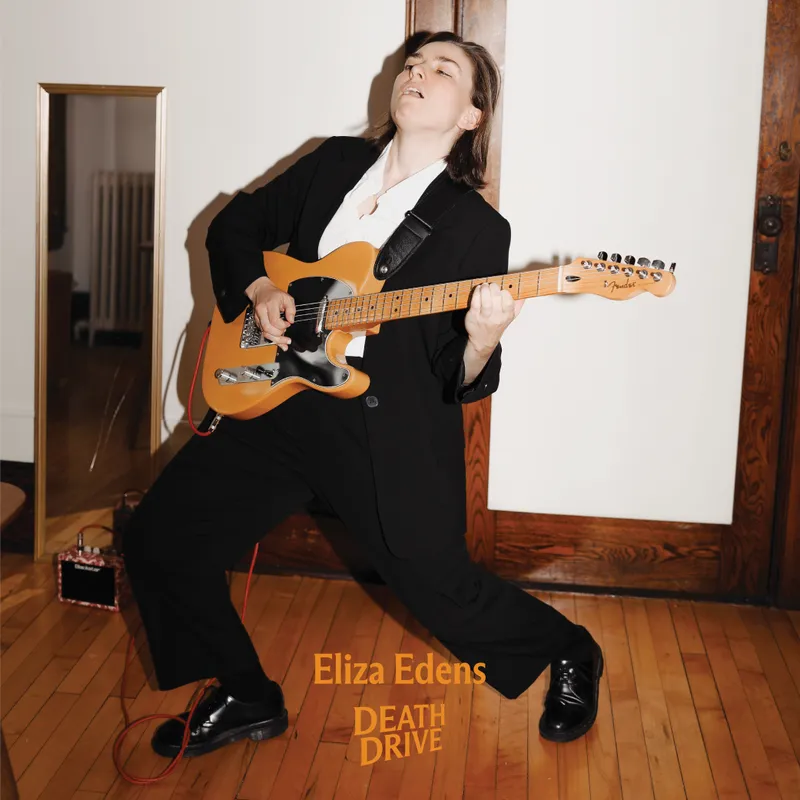
“There’s no shortage of tough times,” Eliza Edens mentions while discussing their new album Death Drive. But despite working through personal grief, Edens has also done an immense amount of productive exploration over the last few years, from dabbling with different musical genres to embracing queer identity to giving in to their bolder side.
The exploration and album stem from the death of Eliza’s mother Betsy after a long battle with dementia. “There’s something about losing someone that makes you feel this sense of urgency about life,” Edens explains. On Death Drive, Eliza shares songs from the point of view of someone following their bliss with reckless abandon. But while some songs on the album carry a devil-may-care attitude (such as “All In Sinnin’”, about fantasizing about hooking up with a married woman), other songs remark on the lingering sense of loss and grief, honoring Betsy’s memory (such as “Bigger”, in which Eliza sings to their mother about new love.)
In an interview with Start-Track, Eliza opens up about the creation of Death Drive, the inspiration behind its new songs, balancing fun and introspection with a dash of hope, and going back on tour to share their stories after a brief hiatus from being on the road.
NOTE: The following interview has been edited for readability and clarity.
WS: Was the title of the album (Death Drive) something you’d been thinking about before writing the songs, or did the concept come to you while you were writing?
EE: It didn’t actually come to me until maybe a year after we started recording the album. We started recording in bits and pieces over about a year and a half. I was reading the Substack of one of my favorite songwriters, Laura Marling. She’s really into psychoanalysis and things like that, and she wrote a blog post about the idea of the death drive. I think she had a line describing what it was about, and she talked about how when she was pregnant with her kid, she was so sad that she couldn’t have a glass of wine to get in touch with her “death drive”.
Then I thought it would be funny to write a song about that concept, so I did. As my producer and I were wrapping up the album mixes, I still didn’t have a name for it. He said, “You should just call it Death Drive, because that’s kind of what it’s about in a couple of different senses.”
WS: Were there any songs you’d written for the album before you thought of “Death Drive” which already fed into the theme?
EE: Yeah, I’d written the first song on the album, “All In Sinnin’”, before coming across the concept.
WS: Compared to your previous work – like We’ll Become The Flowers which was a lot more tender, and it’s your birthday and you’re gorgeous which was a lot of voicemails and voice memos – this album sounds more boisterous, for lack of a better term. Was that a deliberate choice, or did it just happen while you were writing.
EE: A little bit of both. I think I was sick of touring so much and playing all these sad songs to people. That was a big part of it. Another part was embracing my love of pop and rock music. I’d always loved that kind of music, but it hadn’t made its way into my songwriting before.
I think embracing my queer identity throughout the writing of the album – and in the couple years before it – also affected the music I was making. You’re coming into the fullness of yourself when you do that. So I feel like this is a much more accurate representation of the music I love to listen to, which is all over the map: Country, folk, a little R&B, pop, rock.
WS: What are some of your influences? Is there anything you’re listening to right now that’s influencing your sound?
EE: When I was starting out songwriting – about ten years ago – I was obsessed with alternate and open guitar tunings, Nick Drake, Laura Marling, Joni Mitchell, John Fahey. I was really into that America primitive guitar sound like Elizabeth Cotten’s, and old fingerstyle blues music. I loved putting my guitar in a weird tuning and figuring out how to play in it. I wrote a lot of my older songs that way.
There was a hipster young part of myself that thought, “I love all this niche guitar music, and that’s what I want to be like. I’m going to play in all these weird tunings.” Then you’re on tour, trying to play a set in four different tunings, and you’re like, “This sucks on one guitar!” It’s not fun going from open-C to drop- D to open-G. It was a nightmare! I remember doing a tour with three guitars once, and I’m never doing that again.
It got to the point where I felt like I was trying too hard, and it was exhausting, and I just wanted to have more fun with music. Over the course of recording this album, my mom was dying, and I was already feeling so sad and experiencing immense grief. I wanted to have fun playing shows and not be in that heaviness. I can have some songs that are heavy, but I was trying to grasp for more levity, because that’s what I needed at that time in my life.
WS: Speaking of touring, you have some dates coming up, and they’re your first in a while. Are you looking forward to getting back on the road and sharing these songs? And if so, what are you looking forward to most?
EE: I’m definitely looking forward to sharing these songs. At least the fall tour dates will be with a band! I’m looking forward to having fun on tour and onstage, and connecting with audiences who want to feel that whole dynamic range: A fun, goofy song about dating, but also a sad, tender ballad about grief and loss. I’m looking forward to sharing the whole spectrum of what it’s like to be human.
WS: That struck me when I listened to the album. You have these fun songs like “All In Sinnin’” and “Hot and Mean”, and then you have the more tender and introspective songs about grief like “Bigger” and “Hand In My Hand”. How important was it to find a balance between the fun and getting out there – the death drive – sort of thing, versus looking inward and dealing with everything else going on?
EE: I feel like they all overlapped. One thing that comes to mind is that we ended up putting bongos on every song, even the sad and quieter ones. It became a running joke, since bongos were already on half the songs, so we thought, “Okay, we just have to do this now. We have to commit to the bit.”
Some songs are definitely more fun, and some are sadder and more tender, but a number of them mix the two. Life is nuanced, and so are grief and joy. I think mixing those emotions in the songs and the production made both extremes stronger and more powerful.
WS: A lot of these songs came from your daily writing exercises. How much from those exercises didn’t make the record, and why did you choose the songs that you did?
EE: A lot didn’t make the record. Some of it just wasn’t very good, and some of it went on it’s your birthday and you’re gorgeous, the voice memo collection.
When I’m selecting songs to make immortal, essentially – recording them and putting resources into producing them well – I try to choose songs that have a sense of hope. Think of “Sad and Beautiful World” by Sparklehorse. It’s a pretty sad song, but there’s some hope in the way he sings it, in the chord progression, and in the production. With each artistic statement, I try to have a sense of hope, because that’s what resonates with people. I want to look back on my work and see and feel that.
I don’t want there to be bitterness or anything too cynical. If that comes out in a song, then I guess I needed to express it that day, and I’ll let it die. I won’t give it the microphone for the rest of time.
WS: Going back to when you finished sequencing the album and writing the songs: When you listened later, did anything about the songs change for you? Did you hear something in a new way?
EE: Honestly, I haven’t. I’ve tried not to listen to it that much, because I listened to it so much during the mixing and mastering process. I really haven’t listened to the whole album since it was being mastered. But part of me thinks, “Wow, there was a lot going on!”
It’s nice to have some distance from it now. I think that’s the final process of creativity: Packaging it up and sharing it with someone. It’s like giving a gift and it isn’t a gift until it’s given. It’s not music until it’s heard.
WS: That’s a beautiful way of putting it, actually. If someone’s listening to the album for the first time, what’s one thing you’d want them to take away from it?
EE: I’d want them to feel really seen in whatever grief or experience of loss they have, and also to be able to get up and dance and rock out to the rock songs, to feel the freedom and liberation I felt when I was writing some of them… Just to feel that dynamic range of freedom and joy and pain, and to feel seen in both of those experiences.
WS: We’ve been covering a lot of songs and albums with this kind of theme lately. It’s nice to share something that helps people get through tough times.
EE: There’s no lack of tough times to get through. (laughs)
WS: Yeah, it’s wild out there. So you’ve written all these songs, and you had this long period of writing every day. Now the album is done, and I know you’re going on tour. Are you writing anything now, or are you taking a little siesta from writing to focus on yourself and touring? What’s going on right now for you?
EE: I haven’t been writing that much lately because I’ve been doing a lot of marketing and promotion for the record. I do have some new stuff recorded—a few songs—and I’m leaning toward making some kind of EP, but I’m not sure. Once I get this album out and feel a sense of completion with it, I think I’ll be able to move forward more clearly.
This was a big album for me personally, and I feel a sense of relief: “Thank goodness, it’s all over; it’s done.” It’s been a big buildup. I’m excited to reapproach writing with a new sense of freedom. I felt very free while writing these songs, too, but I want to feel a little more unhinged and less precious about releasing music. I put so much focus on the album, and I’m excited to just release a little bit.
WS: I’m excited to hear what comes out of that. One question we like to ask in interviews is: What’s one piece of advice you’d give a newer artist who’s trying to get music out there and share themselves with the world?
EE: I’d say don’t be afraid to imitate other people—not plagiarize, but be open to influence. Music is social at its core, and all genres are built from people being influenced by other people. Listen to as much music as you can. Listen to the music you love, and use it to make what you love. Get inspired by as much art as you can. Then you’ll make your own original mix of influences. I think that’s where originality in music comes from: People have so many influences that the result sounds like something new.
When I was starting out as a songwriter, I’d learn other people’s songs and then write songs that were clearly inspired by them. I think I’ve developed more of my own voice over the years by continuing to do that and continuing to be influenced, whether lyrically, harmonically, or in production. Be a voracious, attentive listener. Also, make music with your friends and trusted collaborators, and stay in conversation with them.
WS: That brings me to another question. On Death Drive, you brought in a lot of friends and family to help with the songs. What was it like to bring them in on certain tracks? Did you already have the idea of bringing them in, or did their contributions change how the music was made?
EE: I think it reflected what I needed at that time in my life. I was going through a very lonely experience, losing my mom to dementia. I could relate a lot to my brother, but not many of my peers were going through anything remotely similar. I had a therapist who was really insistent on reminding me to rely on others, open up, talk to people about what I was going through, and let people in.
I’d thought of myself as a solitary songwriter. You know, you go to a cabin in the woods and write your perfect album. I wrote a lot of these songs alone, but the production and recording were incredibly collaborative and communal. I’d worked with my producers for a long time, and I also brought in musician friends from New York. I think the songs are stronger and better for that. It was a nice reflection of wanting to branch out and include others in what I was going through—trying to lean on friends more.
WS: You’re based in Brooklyn, which I love: I lived there for ten years and used to go around to different places to perform. What are some of your favorite places to play or hear music there? Have you heard any Brooklyn artists you’re a big fan of right now?
EE: One of my favorite places to see music actually shut down about a year ago. It was called the Owl Music Parlor. It was run by an artist and was an incredibly artist-friendly venue—a really cool listening room. It had all kinds of music: experimental jazz, indie rock, everything. That used to be my favorite place. A great place I love going to see music is Bar LunÀtico in Bed-Stuy. It’s more of a jazz place, but the music is always incredible, and so is the food. I also like going to Cassette in Ridgewood. There’s a whole indie scene in Ridgewood. I feel like the great spots are harder to find these days, and a lot of venues take at least $250 off the top if you’re playing. Rockwood Music Hall is gone, too. I used to go there a lot. It’s been a little tougher.
WS: A lot of stuff is moving towards Bushwick and Ridgewood.
EE: Yeah. Other artists I’m excited about… There’s a really great artist named Hank Heaven who’s starting to take off. There’s also this guy Renny Conti. He just put out a great album (and he has an album release show today. I can’t go sadly!) They’re both local artists, and they’re two people I’m excited to check out.
WS: My last question: You came from the Berkshires to New York. How do you think Brooklyn affects your sound? Has living in New York affected it, or does your environment affect how you create music?
EE: I think it definitely makes me want to play music that’s a bit louder in some ways. But I feel like I’ll always write whatever I want to write, separate from the environment.
WS: Is there anything else you want to highlight about the album or any songs?
EE: I really liked working with a string arranger for the first time for this album. For “Hey Mama”, I wrote a demo for the string arrangement and sent it to Oliver Hill in L.A., who’s incredibly talented and works with a lot of cool people. I loved how that song turned out. It made me want to do more songs with strings, although that’s a little expensive.
I’m really proud of that song. I feel really proud of this album and all the work the other collaborators put into it, and I’m trying my best to spread the word. It’s a tough industry.
Eliza’s new album Death Drive is out now. Take a listen to the title track below.
Written by Will Sisskind
