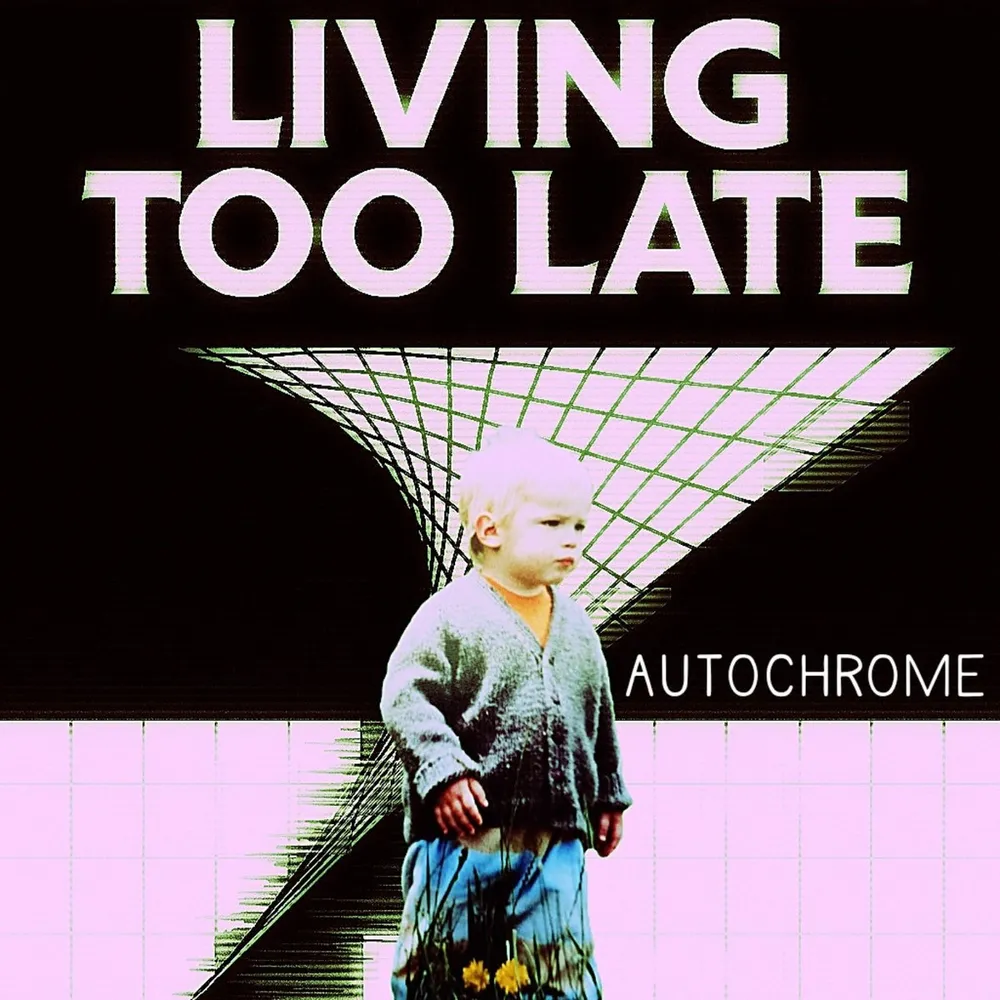
Whenever I’m looking for a way to start an article about a piece of music, I check out the area of the world where the artist calls home. And so we turn to Adelaide, the largest city in South Australia, where folks are starting to bundle up for the cool season while I fan myself in New England’s early summer stickiness.
This city is home to Living Too Late, the latest music project of Jakub Tengdahl, formerly of other South Australian acts such as It’s A Hoax and DEAN FOREVER. Tengdahl is a songwriter and multi-instrumentalist who covered almost every base, recording his new album, Autochrome. In fact, while he recorded his vocals, guitar, drums, and keys, the only base he didn’t cover was the bass, which came from Matt Hills. (Hills also took care of backing vocals as well as mixing and mastering the album.)
Because of Tengdahl’s and Hills’ collective experience in the scene, although Living Too Late is a two-person operation, they make every song on Autochrome sound much bigger than the sum of their parts. The opening of the album’s first track – the title track, no less – brings bubbly synths and an expansive guitar solo that could fill an arena. Tengdahl and Hills sound like the Pumpkins, Built to Spill, and Dinosaur Jr. sharing a festival stage, perhaps during the months when the median temperature in Adelaide isn’t in the teens (measuring in Celsius, of course).
While the music shines on Autochrome, Tengdahl’s songwriting pops with poetic lyrics dressing up relatable themes. The title track takes its name from one of the first color photography processes, which was hugely popular in the early 20th century before film came along to overtake glass plates. Tengdahl found the idea of once-famous things fading away “strangely relatable”.
Perhaps that’s part of the charm of this debut and Living Too Late as a whole. Their sound takes from the late ‘90s and early ‘00s, but rings fresh to the ear. It has an intensity that sends a chill down the spine, but is lush enough to get hot blood flowing. The contradictions work with each other to power Autochrome, and thus the album is accessible enough for anyone to pick up and enjoy, with hints of complexity to keep discerning listeners interested.
The title track and “Starting To Be” utilize a heavy indie sound before delving into grunge territory for “Escape”, which lends well to Tengdahl’s higher and more melodic voice. Often grunge vocalists take on a snarl or keep their range somewhat limited; Tengdahl, however, hits every note with intensity and passion. “Escape” ends with a repeating and blistering riff that played live could close out a set and buckle the venue’s support beams through sonic power alone.
As one of the more topical tracks on the record, “Lease Extension” does not hold back in its rage against landlords. Here, Tengdahl and Hills go the Nirvana route: The vocal cords strain as Tengdahl screams his lyrics, and the guitars and drums split open their targets to disembowel them alive. “I thought there was something worth exploring in the anxiety, frustration, and low-level paranoia that modern renting seems to produce,” Tengdahl says about this track. Oh, my friends, as a longtime and perhaps forever renter, I felt this song in my bones. Many times I’ve wanted to scream at my landlords as loud as Tengdahl does on “Lease Extension”, mostly because such extensions came with a “rent extension”.
Tengdahl keeps the vocal intensity high on “Returning Cavalry”, an early single from Autochrome that features math rock and post-hardcore influences. The inclusion of those styles was meant to differentiate it, as well as everything to come from Living Too Late, from the music of Tengdahl’s past. There’s also a touch of influence from the Pixies, and Tengdahl’s switching between precise yowling and powerful melody gives vibes of Frank Black. A panicking square wave arpeggio adds to the anxiety inherent in the track, highlighting the math rock influence without pitching it into chiptune territory. Tengdahl cites Goethe’s Faust as a lens for the lyrics, and the music certainly matches the emotion of the source material.
“Conduit” is a more straightforward jam, centered on the idea of “less analysis, more action”. It does what it has to do in its three minutes, with a wonderful explosive breakdown at the end before closing with a traditional studio fade (which is, I feel, a rarity in music these days). The band doesn’t stray far from math rock territory, though: “Swarm The Anomie”, written close to “Returning Cavalry”, toys with 7/8 time, with the drums keeping a lock on the groove regardless of the time signature, even as the other instruments fall into chaos around them.
“You’re Not There” was originally called “Pavement Song”, according to Tengdahl, and the Pavement influence comes on strong from this track. While the other tracks on the album pay homage to Gen-X alt and indie greats, “You’re Not There” is the one that sounds like it could be a faithful cover. Of course, this is not to accuse Tengdahl of lifting directly from any artist. It is to speak of his talent and ability to capture the sound of a generation of slackers, latchkey kids, and folks unsure of the future their forebears have preordained for them. I could invoke either Gen-X or Gen-Z with that statement. You pick.
Finally, there’s the two-part “Time Waits”, with the first part ending Autochrome’s first half and the second part wrapping up the album. Part 1 leans into the sound of early-2000s post-punk, as Tengdahl was listening to lots of gloomy New York indie bands while writing it. (There is plenty of The Walkmen and TV On The Radio coursing through this track.) Part 2 keeps the guitar riff and the gloomy influences, but picks up the tempo and sounds like a solid Foo Fighters song. It roars right up until the final minute, save for bits throughout where the repeating keyboard riff makes a solo. Then, we re-enter the land of rhythmic chaos, where Tengdahl hearkens back to his musical past to close out a new chapter of his music career.
Autochrome is a lovely rock album for any weather, be it the breezy winter of Adelaide or the sticky summer along the Atlantic shore. It’s both brutal and beautiful at the same time, with enough intensity to keep the heart thumping but enough melody to itch the eardrums. It almost feels wrong to call this a debut, as this is not Tengdahl’s first rodeo. Let’s just call it the turning of a new season.
Take a listen to the title track from Autochrome below.
Written by Will Sisskind
