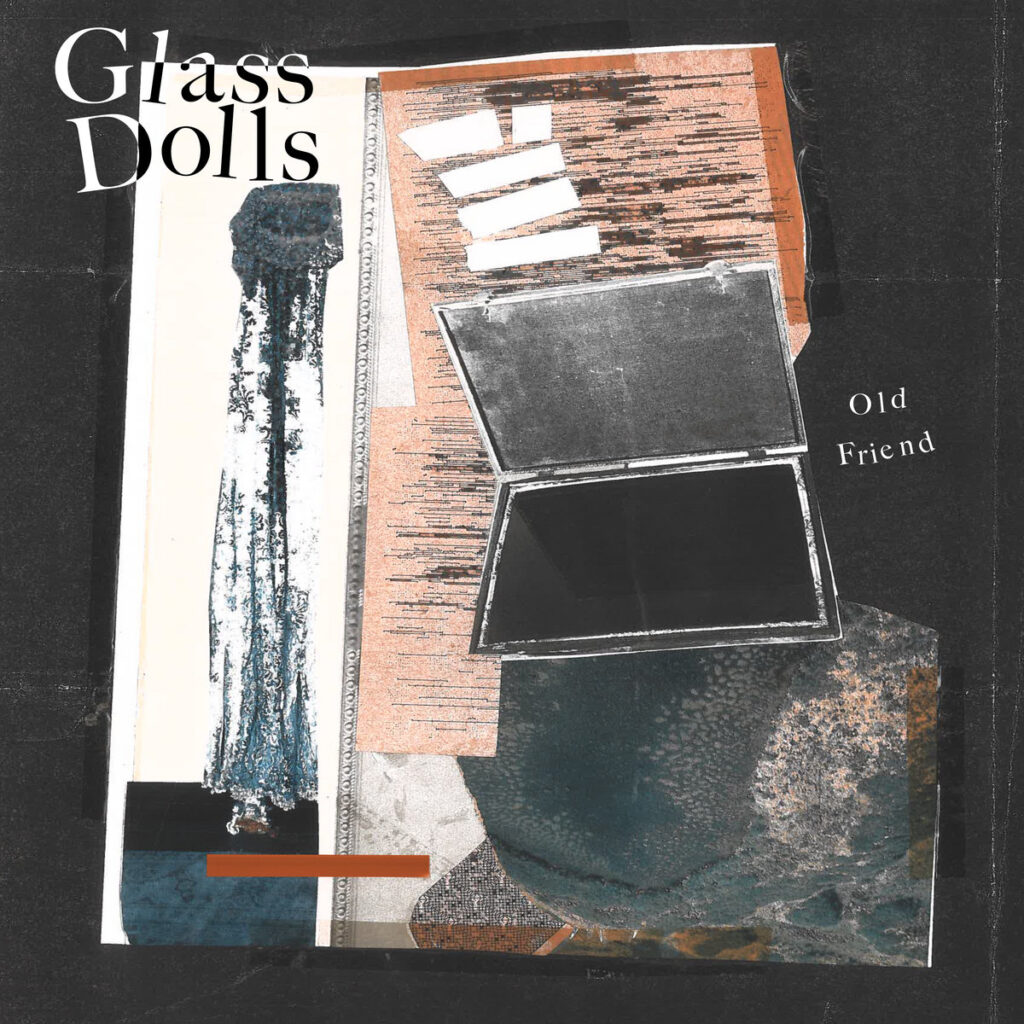
From Montreal, Québec, Étienne Zebell Grenier presents us with an “Old Friend”: the new full LP from his project “Glass Dolls”, which precedes the EP “EP” (reviewed on our blog).
He presents “Old Friend” as “an album about love, loss, and grief. Heavily influenced by the Cure, Cleaners From Venus, New Order, and the Clean”.
Starting with “Echoes”, it marks right away a departure from the harsh-distorted production of the previous “EP”. Though still immersed in the electronic beats, swirly goth vibes, and cutting synths, it seems we’ll navigate into a more nuanced realm of storytelling songs, a bit less “physical”, less frenetic and punchy, but more hesitant and vulnerable, with more space for the vocals to convey their meaning to the listener. “Echoes” is a good kickstart to the album: short of words but meaningful, where indeed grief and loss take their part, and an easy, paradoxically almost danceable melody.
We’re struck with the self-explanatory “People come and go” as a mantra in the following track “Disambiguation”. A poetic, personal writing that seems to try finding meaning in the ambiguities of love through its own cyclic repetition. We are born, and we die, we love, and we fall apart. There’s beauty in “the bloom of dusk” and in “the bite of spring,” while a soothing chorused guitar cries. We are then taken into an uneasy feeling of anxiety in the middle of the song, and just when despair starts to kick in, it turns back into the resigned mourning of a much-needed disambiguation. “Do you recognise”?
I heard the next song, “He is With Me,” as a psychoanalytic dive into the theme of dissociated parts of the Self. The words “he speaks to me in my voice / he walks in my shadow / he sees everything“ and “what does any of it have to do with me? /stuck on the outside looking in” take me to painful, unprocessed feelings, taken by a depersonalised persona, looking itself from the outside, unable to recognise oneself. Who am I to guess? Maybe it’s just the mourning of someone so close to us that we take their loss as part of ourselves. What’s cool is that this is said with an ironic and highly danceable happy song construction à la “The Drums”, with an unapologetic beat. And that’s precisely the beat to exorcise your ghosts while singing confidently, “I can’t think about anything else / when the feeling comes and takes a hold of me” till the end.
“Hesitation” is probably the one closest to the previous EP in terms of production. A beautiful six-verse poem, a bit forced into a good instrumental like an unfit puzzle piece, carried by the pungent bass and beautiful synths, not too different from the rest of the album. A nice piece, a good filler in the story, it seems; it doesn’t add too much, doesn’t take anything away, either.
What can I say about “Misha”? The lyrical imagery fits anyone’s imagination. It comes out (not that it has to be in its core) as less personal and more symbolic. A song where words have no meaning without the atmosphere. It means something to me, I just don’t know what. That felt uncanny, and I like that. Not a masterpiece, probably what’s considered a B-side, but emotionally honest and somewhat mysterious, and that is enough.
Oh, how lovely is the melody of “You’ll Never Know the Truth”! I could eat it if I were hungry enough. What a great start, and with just the right amount of breathing time before the vocals. The lyrics go so well that I honestly couldn’t care what they said. It’s the example where mundane lyrics (wait, it’s a compliment) and their metric are so well integrated into the song and its atmosphere that they gain a deeper meaning (say, some Beatles songs?). Then the metric changes, the song gets fuller, and better. It’s a Pop song, and you didn’t know it. It’s a Pop song I wish I had written. Reminds me of John Maus at his best.
Another beautiful song comes with “Don’t Let Her Go”. A minimal instrumental, a declaimed poem, and it’s all it takes. Nop… “and a whole lifetime passed” and here comes a chorus with vocal nuanced changes worth being repeated till the end: “don’t let her go/think of everything she’ll never know”. Some details break monotony, and that can make a difference when hearing a full LP as a whole.
“Disconnected Tone” comes as an honest and descriptive grievance over loss. It’s difficult to hear “I picked up the phone / to dial your number / just a disconnected tone” and not take it as so very vulnerable… The phrase “just a disconnected tone” is repeated till the end, much like a disconnected cry. It is what it is, and it should not be anything more. In the middle of despair, once more, a catchy tune with a catchy melody with subtle dynamics. Who would say “grief” and “catchy” would go together?
“Black Cloud” is a raw dialogue between a Joy Division-like rhythmic section and a mix of ethereal and disconcerting guitars. The lyrics are straight to the point in a naïve manner. Grenier spits them out as a fucking lament: “I just fucking miss you” is what it’s all about, in all that death and absence comprises.
“Trapped” follows a detuned, at times atonal vibe. We indeed get trapped by a really cool background synth lick and great guitar work. It gives a sense of obsession, solitude, and dread. A eulogy to the trapped ones: we’re flesh and bone just like the others, but something may be different inside.
“Pandora” comes with a Jungle beat hidden behind a goth atmosphere. I’m taken into a cave somewhere in the London suburbs. Slightly inebriated, I hear the calling on repeat: “open up the lock, throw away the key, oh my Pandora, how the time does fly”. The track changes key, and the poem starts. Somehow, the words “it was the taste of blood, it was the loss of faith, it was the emptiness” don’t sound that dark. They acquire a different taste. They are music now. “It’s everything and nothing at all”.
The track “Old Friend” could be a Beach Boys song wrapped in an old cassette tape. A gem of a chorus intertwined with a childish “Oh my old friend/ Wanna play kick the can?/Find the marbles in the sand”. The smallest song, but such a joy to listen to, in its child-like simplicity.
The album ends with “I Can’t Cry Anymore”. A resolution. There’s less ambiguity here, more resignation. Not much sonic fluctuations. It takes its time, but it is it. It’s the end. It’s still about death and loss, but it’s not symbolic, rather direct and personal. The verses turn a simple inner dialogue about one’s end and another’s continuation into a beautiful poem. The words “you would have told her not to cry anymore” glow as an act of love and courage, in an honorable end. In Memoriam.
—
It is not an original style or genre (see the artist’s self-claimed influences and the ones pointed out along the way), and to be fair, it doesn’t need to be, nor does it seem, by listening to “Old Friend”, that it has any pretence to be. That’s why this review does not dwell too much on the particularities of this kind of production, but rather focuses on the raw substance of the emotion, storytelling, melody, and song construction presented. I would just say, not to make it completely absent, that “Old Friend”’s production is very cohesive, and its quality does not envy too much any John Maus or Ariel Pink alike. It’s well balanced, not too monotonous throughout the album, and with just the right amount of low-fi-ishness, with a variety of very well-designed synths, some almost edible, and a non-negotiable bass.
“Old Friend” flows well, in a clear direction and in a defined sonic space, though with enough variety not to become monotonous. It is a dark album, with a good amount of irony and “sonic humour” to counterbalance it. You may feel guilty, but you can dance through it.
Overall, the song construction and the feelings it brings seem to be in touch with the words spoken, much like a baroque piece with its many stages.
“Old Friend” is also marked by such well-written pieces: sometimes lyrics to fit into the sound, sometimes poems, sometimes “beat” or rooted and descriptive, and others ethereal and symbolic. The use of repetition is used repeatedly, and if it is used repeatedly, it’s likely because it’s worthwhile to be repeated. The vocal interpretation has a strong personal touch, and while mechanical at times, doesn’t throw emotions out of the equation, and well so, in that they color these tracks much like its bass: you would only notice it in its absence. I feel in a few songs (much unlike the track “Old Friend”) the relationship between the spoken-word and the instrumental could benefit from a more detailed and thoughtful integration, even if that could let aside some of the beat, raw, unpretentious, and straight-from-the-heart feeling.
It is a pleasure to hear the complex and devastating subjects of human grief, death, loss, and angst wrapped up in love and transformed into art for others to take in.
On an ending note: I really liked it when the tracks entered a more Pop-oriented construction. It seems “Glass Dolls” goth atmosphere also mixes well with candid, undistorted vulnerability.
This review does not use AI in any form, neither for writing nor correcting or aprimoration purposes.
Written by Hugo Hugon
