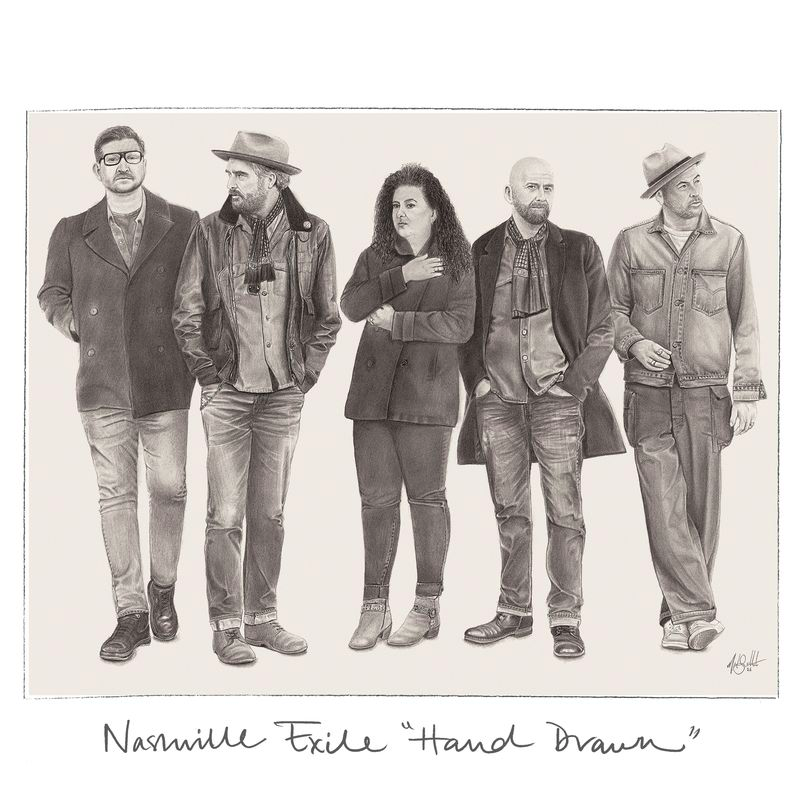
Opening with a combination of quintessentially American-feeling warbly, twangy guitar and a smooth, steady, sophisticated rhythm section, Nashville Exile set out their stall immediately on their new album Hand Drawn.
With classic rock n’ roll references like Tom Petty and The Rolling Stones, and with actual lines taken from a well-known classic from Jefferson Airplane (“Don’t you want somebody to love? / Don’t you need somebody to love?”), this feels instantly very much like it’s a successor to those immortal acts that came before them. The songwriting is classic, traditional, and lovable. The execution is absolutely faultless, so much so that you may be surprised to find out – much like when looking at our own Americana-infused outfit, theCrates – that the band is not from America at all. Despite their name, Nashville Exile is based in The Big Smoke. (That’s London, England, for those who don’t know). In terms of more modern contemporaries, we’d say this track – a single named “Collide” – is operating in similar territory to acts like Ryan Adams, Fleet Foxes, and The Raconteurs at their most reserved.
The band takes the pace down with the second track, “The Alchemist”, one of many previously released singles from the album. Again, you can’t help but be hit by the professionalism. It glistens just the right amount, with the sheen never overpowering what lies beneath: It’s excellent songwriting and musicianship, perfectly poised and beautifully balanced. We’re reminded of the phenomenal (and phenomenally overlooked) debut album by Irish trio Hal, as well as Howl-era Black Rebel Motorcycle Club or Cassadaga-era Bright Eyes. The subtle slide guitar, the rhythm of the guitar strums, the luscious backing vocals, the bass notes placed exactly where they are: All these elements and more come together to make something that is more than the sum of its individual parts.
On the third track “Told You So”, the female vocals come to the fore. Previously used sparingly as a counterpoint to the vocals of frontman (as well as guitarist and producer) Matthew Croze and Amu Dennett, Cat Smithurst takes centre stage, backed by a gritty guitar lick and the ever dependable rhythm section. (Shouts out to Mark Smithurst – Cat’s husband – on bass and Rick Kent behind the kit). Her honeyed vocals ensnare and enthrall, while the band is at their poppiest yet. The searing guitar solo at around halfway through cuts through the polite and traditional-feeling song structure like a hot knife through butter, before leaving almost as suddenly as it came. Another prior single (as every track here could’ve been!), “Told You So,” feels familiar, like a ’90s hit that you forgot all about that unlocks a core memory when it comes on the radio. It’s a memory of better days and simpler times.
“Flowers And Suicide” is the first track here that wasn’t previously released as a single. It’s a delicate, heartfelt lament with lyrics that are as ambiguous as a song entitled “Flowers And Suicide” could really ever be. Cat takes the lead on this one again, singing lines like “All the scars you hide / I can’t resist your cries / So just take care” and “Kiss goodbye the love that you made / Can’t bear to see you throw it away”. The arrangement recalls the work of Emmylou Harris and Daniel Lanois on her seminal album Wrecking Ball, and maybe also a little bit of the collaboration between Jenny Lewis and The Watson Twins. Intensely moving and – we would assume – deeply personal, this feels like an emotional tribute to someone we never knew, but find ourselves missing nonetheless.
The most recent release, “Change,” is up next. The contrast between Cat’s lead vocal and the voices of the others is what struck us most on first listen, closely followed by the instrumentation and some of the bold stylistic choices. (It’s always good to hear a harmonica. Is that a lead part played on acoustic at around a minute in? Is that a ukulele we hear somewhere in the mix? Nice work, Seth Von Paulus!) Again, the songwriting is top-notch. We’re reminded of the David Bowie classic “It Ain’t Easy” combined with the more modern sounds of the band Birds Flying Backward. As the third song in a row featuring female lead vocals, Hand Drawn is starting to feel like The Cat Smithurst Show! “Change” is the most country the band has sounded so far on the album, and it’s an excellent example of their musical versatility and adaptability as a whole.
“The Spark” is up next, and it sees the return of Matthew Croze (who, incidentally, is actually the cousin of Mrs. Smithurst) on lead vox. It keeps the alt-country vibe going and blends it with the undeniable pop sensibilities of earlier tunes like “Told You So,” fusing two of the band’s strongest attributes to make what is perhaps the most well-rounded song so far. The Tom Petty vibes are back with a vengeance on this one, but – similarly to fellow UK-based ’70s rock revivalists Nuclear Family Band – it is accompanied by a distinct individuality that is absolutely essential.
“Bye-Bye Baby” employs a piano and what sounds like a banjo, which is a nice tonal shift. Cat is back on lead vocals here, and she sounds absolutely timeless. She soars above the melange of instruments beneath her and rides on the wings of the band as they begin to take flight. At around halfway through, the song breaks down, and it becomes reminiscent of Rilo Kiley at their most commercially successful.
“Sing Our Song” is up next, and it’s not hard to see why it was selected as one to put out ahead of the release of the album. Soulful, swaying, and smoky, it’s the sort of song you imagine playing in a bar in rural Texas, Arizona, Idaho, or Nebraska. Really, it’s one that plays anywhere dusty where the locals all turn to look at you as you walk in the door. Full of personality and conviction, the highlights are the use of slide guitar and the overall balance of the arrangement.
This is followed by the fantastically titled “Dance Like A Motherfucker”, which is basically a Southern-fried party anthem. It conjures images of hoedowns, honky-tonks, flowing liquor, and good times. The overriding emotion for the listener is one of pure joy, but dive deeper than the surface level jubilation, and there’s loads to appreciate musically. The biggest standout is the backing vocals and the return of the banjo. It also features what is undeniably the most surprising aspect of the album so far, in what sounds like the use of a vocoder. We did not see that coming.
“Almost Gone” returns to more familiar territory with a song that feels a bit like The Brian Jonestown Massacre slowed down and chilled out. With Cat back on vocals, this one lilts lazily, like the breeze on a summer night, and it leads nicely into the album’s closer, “Lights Down.” It’s a minimal arrangement that reminds us of the rootsy, unapologetic earnestness of The Low Anthem mixed with the songwriting strength of Teenage Fanclub and the charm of Belle & Sebastian. It’s a stunning way to end what has been a tremendous album.
Littered with highlights and teeming with talent, this album and this band know no bounds. Stream Nashville Exile’s Hand Drawn wherever you get your music, and watch the music video for “Almost Gone” below.
Written by Black Rainbow Collective
