I’ve been listening to two albums named Good Grief quite a bit. The first is from Sara Bareilles, who has millions of fans and streams and a handful of awards for her work in music and theater. Her Good Grief is a tender, cinematic exploration of loss and recovery that tears at you, peels back your skin to make the nerve endings raw, but ultimately lends you its shoulder on which its lets you lean your head, telling you it’s okay to not be okay.
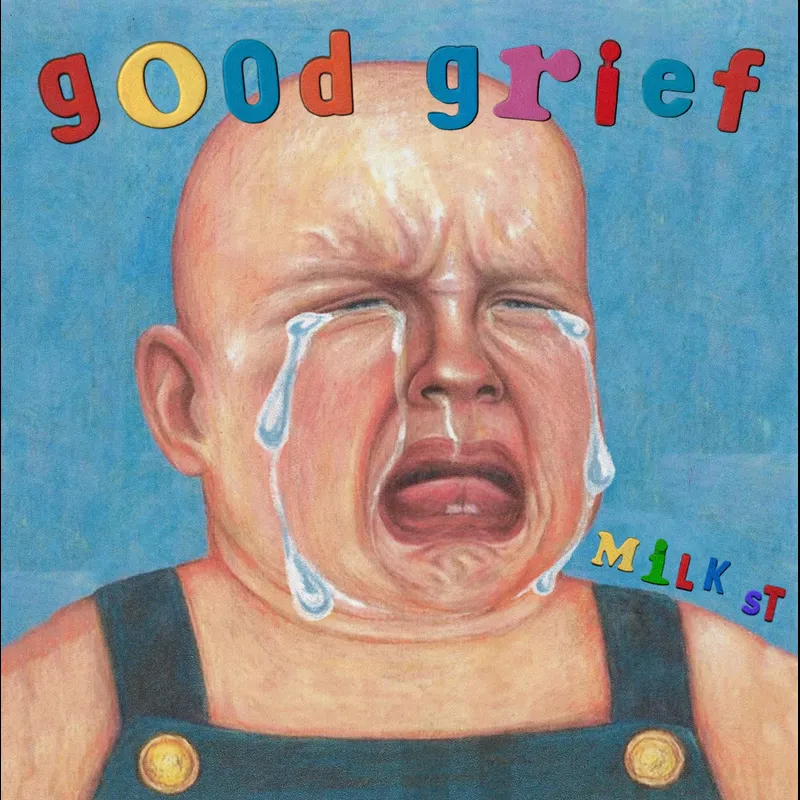
The second is from Milk St., a band who should have millions of fans and streams and a handful of awards. Their Good Grief does what Sara’s album does, except through blistering guitars and noise and ear-splitting delight that makes you want to scream along. The music world contains multitudes.
Anyway, Good Grief is Milk St.’s third album since forming in 2022, and it sounds like Jonah Wakefield and friends put everything they had into this one. Few moments of relief greet you on this incredible work, which runs for a lucky thirteen tracks clocking in at just over fifty minutes. Not to say that you’ll want relief: Milk St. put on such a show of catharsis and release that you’ll find yourself unloading your baggage and expunging your demons right along with them.
“Henry” – the album’s thirty-eight second intro – reflects this, as a collection of sounds to set a scene rather than a song. You hear the radio static, the guitar practicing, the distant arguing, and then two voices shouting “Hennnnry!” and “I’m coming, Mom.” The themes of anxiety, dejection, apathy, and ennui all come through in that sonic imagery.
Then we launch into “Just So”, a searing ode to frustration in trying to place the source of young sadness. It falls somewhere on the apex of peak Weezer, The Ergs!, and Car Seat Headrest, bouncing between wanting companionship and loneliness, sex and sleeping alone, tenderness and anger. It pinpoints the mentality of a young listless person, which fits so many folks born in the 21st century who don’t know what the future holds for them. But God dammit, they will make their frustrations known! And God bless them for it!
Speaking of Weezer, “Toyota Corolla” is a song I feel like they would have written back in their heyday. As a fan of that band’s earlier work, many thanks to Milk St. for writing this track. It is a perfect self-deprecating soft-boi song, in which Wakefield sings to a romantic partner who sees him as much more than how he feels. He sings: “Talk to me / In your head I am a limousine / I always thought I was more of a Toyota Corolla cruising down the street.” He wants to do everything he can to make himself perfect for the person who loves him, fearing that any fault will drive them away. Even if he’s a Corolla, he’s going to make sure he’s washed, polished, and detailed to the letter. I identify with this song, as I’m sure many do: Being in love means overcoming our own self-doubt to step up for the person who we want and who wants us. Wakefield sings: “I’ll try to be your zebra, I’ll try to buy a house / I’ll probably never amount to anything, but I will try like Hell.”
On the flip side, the fast-paced and rollicking “Boy Dinner” highlights cigarettes and coffee and general slackerdom. Frankly, my boy dinner is a flat Diet Coke, a handful of Takis, and maybe some leftover rotisserie chicken if I’m feeling fancy. Sometimes you’re just a slob, and apologies regarding the matter fall flat, because you are who you are. And you may apologize for that, but if you can the person who loves you anyway, you keep them, because maybe they have a dinner of their own, and sharing those dinners is an act that binds two souls together.
“Slide Off” has a little bit of grunge to it, making it taste a little bloodier. On the song, Wakefield reflects on using apathy as coping, but also views doing menial tasks as righteous acts of defiance: “I wanna feel lethal / I’ll brush my teeth, I’ll flash a smile, I’ll change the sheets.” It’s also about what we do to keep ourselves from spinning out every hour of the day, or to keep our most-undesired thoughts and internal conversations from banging about it our heads.
The band temporarily takes on a Springsteen and The Gaslight Anthem vibe on “Milk and Honey”, a thundering track about not living up to expectations and losing innocence. Then, they turn back to slacker indie vibes, complete with DJ scratching sound effects and an “El Scorcho”-esque guitar riff. “Good Grief” is from the point of the view of the aftermath of the emotional storm: The relationship is over, the job offers aren’t coming in, and the best move seems like disappearing. This song’s a builder, going from a quiet first verse (well, relatively quiet for this album) to something much more rollicking and filled with rage. It reflects how anger snowballs, getting bigger as all the troubles start to build on top of each other, until finally they slam against the ground, exploding everywhere and making a mess.
This caps off the first half of the record. On the second half, Milk St. cover more emotional ground: Tracks like “Apple Pie”, “Weed and Crisco”, and “God’s Dad” explore family issues, religion, spirituality, and trying to find a sense of belonging but hating everything that tries to welcome you in. “Montana” also acts as a personal statement from Wakefield, with him forcefully singing the line, “I am a victim of a love-based economy / And I am an artist, and no one can stop me.”
The second half of Good Grief also touches on the moment someone feels the need to walk away from you. The penultimate track “Ronkonkoma” is about former band member Gabe Chambers making the decision to leave Milk St., trading in the van life for something more stable. Wakefield sings about struggling with that change but knowing that he has to carry on for his own sake; his friend will always be there, but he can’t leave the music behind, lest he lose everything that makes him who he is. “Ronkonkoma” is from Chambers’ point of view, as Wakefield tries to see things from his old bandmate’s perspective: Sometimes playing in a band and touring isn’t all sunshine and rainbows, no matter how much anyone romanticizes the lifestyle.
The final minute of “Ronkonkoma” references all the tracks that come before it in one last joyful burst of noise and rage and punk effervescence. Then, “And So On” forms the album’s coda, with its title tongue-in-cheek, as if Wakefield has just finished a sentence with a little laugh and a wave of his hand. Where “Just So” was about a kid wanting to escape his situation, “And So On” is Wakefield letting the anger subside for just a moment and trying to understand how to make the best of things, and perhaps even find some forgiveness in his heart for those who have hurt him. He sings: “Scary old man, I don’t like all the things that you do / Despite it all, I still love you.” This track marks one of the album’s rare moments of tenderness: It is little more than Wakefield and his guitar, recorded on the fly and full of all the live emotion fluttering in his heart.
There is a lot to process on Good Grief, and perhaps it takes repeated listens to truly appreciate it all. But my biggest takeaway from this album comes from its title, which – again – it shares with Sara Bareilles’s latest album. Both records may sound totally different, yes. But they both understand the pains of disassociation and disillusionment, as well as the healing power of grieving, however one chooses to do so. They find – as do I – that expressing this grief in the form of song helps them work through all of the terrible afflictions that have cast their shadows over life. Songs truly written with blood and sung from the gut have a cleansing power. And trust me, there’s plenty of blood, sweat, and tears all over Milk St.’s newest record.
Anyone needing to take an hour to shut their door, close their blinds, and have a good screaming cry should consider Good Grief as a soundtrack. Take a listen to “Toyota Corolla” below.
(Also, this writer would like to thank Bangor, Maine’s Jonah Wakefield for mentioning Moxie in a song. As a fellow New Englander, I gladly rep Moxie anywhere I go. I now feel compelled to buy a case at the grocery store and chug it while listening to Good Grief. Go Red Sox.)
Written by Will Sisskind
