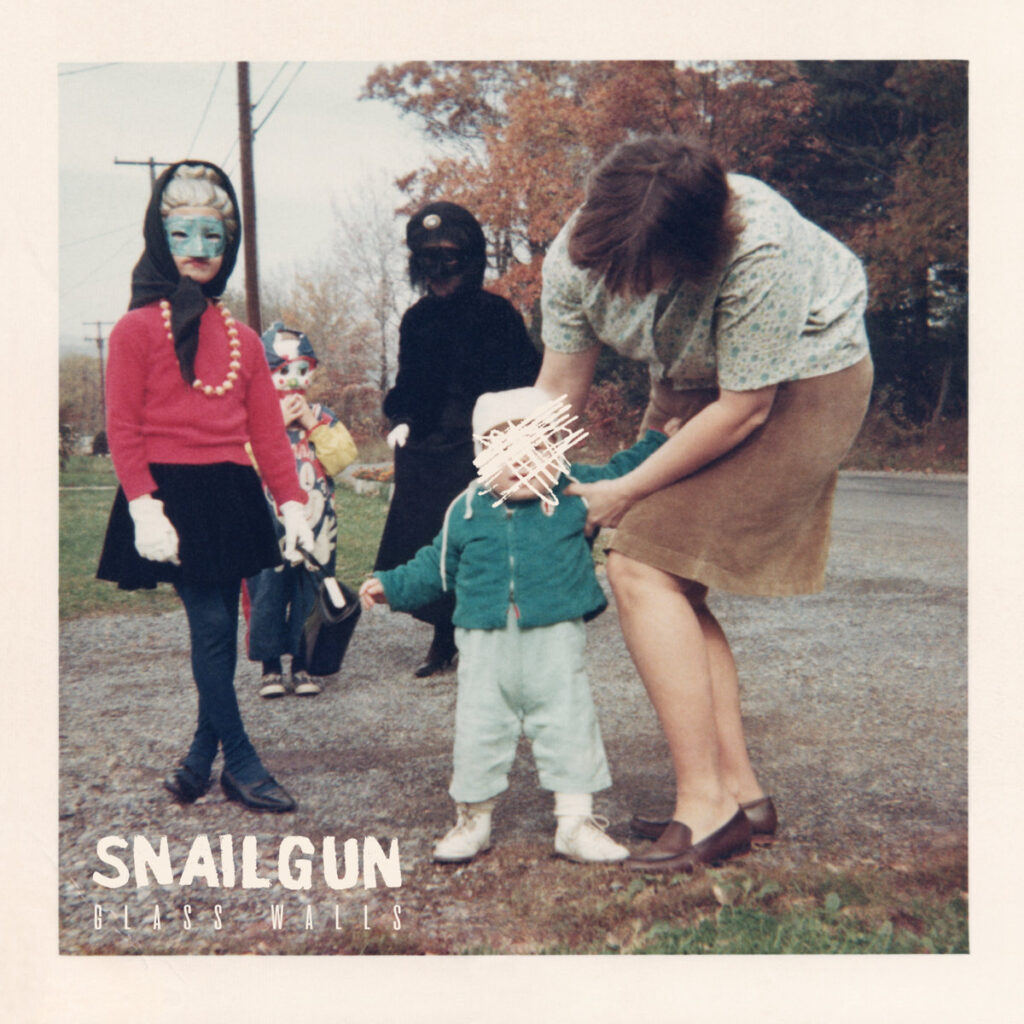
It seems like in the wake of Chappell Roan’s “Good Luck, Babe!”, everyone with some sort of musical knowledge was rushing to cover the song. I don’t think any other act out there gave it a treatment like Melbourne/Naarm’s Snailgun: Noisy, frantic, and messy, much like someone’s mindset when they’re killing themselves to repress their sexuality. If anything, this version really drives that sentiment home. It makes the original sound too clean.
But that’s Snailgun for you: Sharp, sludgy, and all too happy in the dirt. I’ve seen a few other articles around the web call them and their debut LP Glass Walls “acerbic”, “sardonic”, and “nihilistic”. I say they don’t sound afraid to touch elements of rock that most acts today have left behind: The jagged distortions, the blown-out drums, the disaffected but devilish vocals. But the band also knows how to wield such musical weapons.
The band’s massive sound masks their smaller roster. Only three people make up Snailgun: Adam Osth (vox/guitars/keys), Daniel Little (bass/vox), and Sam Maher (drums). Yet this trio makes the sum of their parts seem more like the result of an exponential equation. Of course, other three-piece groups have succeeded in building humongous walls of sound: Muse, Monolord, the Jimi Hendrix Experience, Cream, Rush, and all sorts of big names throughout the power rock/psych/prog/metal canons. Snailgun has quite a ways to go before reaching that sort of global household name status, of course. But they’ve made a giant leap towards that goal, for sure.
Perhaps the sound on Glass Walls would also associate well with the sound of early Nirvana: Buzzy, full of attitude, angular, and in-your-face, without the stink of corporate sheen. “SD”, the album’s first track, begins without pause or fade-in: Here’s Snailgun, suckers. The lyrics of the song exist – three verses, with the first and third the same – but they supplement the harsh and hypnotizing five-minute sonic assault. It is both melodic and progressive like a solid post-rock anthem, but it rages with raw, direct input realness in place of anything cinematic or soaring. If post-rock is water and air, Snailgun’s music is fire and earth: Hot, hard, and unforgiving.
A major characteristic of Snailgun’s music is to go in any direction at any time while staying smooth with the jam. “Labyrinth”, which the band wrote and released last June, is a six-minute soundtrack to music making its way through a maze. The further it gets, and the more lost it becomes, the more frantic and fierce it sounds. Then, suddenly, a saxophone shows up. David Waldie provides the sax, tying it seamlessly into the song, which unravels totally in its final minute. But despite the different ideas in “Labyrinth” and its unspooling sound, it never deviates from its original core. You’ll lose yourself in the track just like you would in an unsolvable maze.
On the flip side of the frustration of “Labyrinth”, “Shadow Operator” grinds away with grunge sentiment, taking a darker tone. As the second single from the record, it gave a hint to fans that Glass Walls would feature the band touching on different musical ideas from track to track, and shows Snailgun’s ability to take on any style with gusto, as well as a little bit of gasoline.
Most tracks on Glass Walls relish in their length, ranging from five to over eight minutes. However, that’s not a default setting. “Straight Ahead” clocks in at just 2:02, but doesn’t need any longer to do its job: Provide fast SST-style punk that will cause some banged-up knees in the pit. Then there’s “Midway I”, a heavy instrumental that builds with suspense into a sensational beat. This track leads directly into “Midway II”, which adds lyrics turning the track into a full punk tour-de-force: “Now in this darkness, years pass / I remember the conversations, but that wouldn’t spare us / Under lights in the open sky”.
Snailgun closes out Glass Walls with two rollicking jams. First, “It’s Called Fear” uses bone-shaking bass and drums and screeching guitars to symbolize oncoming panic. Then, there’s “Screamy Cat”, which features no cats throughout its nearly nine minutes of pure alt-rock bliss, giving vibes of Television and their contemporaries. (Richard Hell and Wire come to mind.) The repetition at the end of “Screamy Cat” makes for incredible headbanging material, which demands playing at full volume, preferably from a garage in a quiet suburban neighborhood.
Many early listeners to Glass Walls have compared Snailgun’s sound to British post-hardcore band McLusky, although Snailgun takes that assertive sound and add some jagged edges of their own for maximum damage. They harp on musical phrases until they explode, playing them more intensely until blood, sweat, and tears drip from every note. It’s the kind of sound that embraces the world of today: Watching everything grow more intense through giant windows and feeling the glass rattle, and knowing it’s going to shatter soon, but being too entranced by the terror to turn away.
In any case, the noise on Snailgun’s Glass Walls will help you mask out the noise going on in the world today, if you’d like. Take a listen to the new record below.
Written by Will Sisskind
