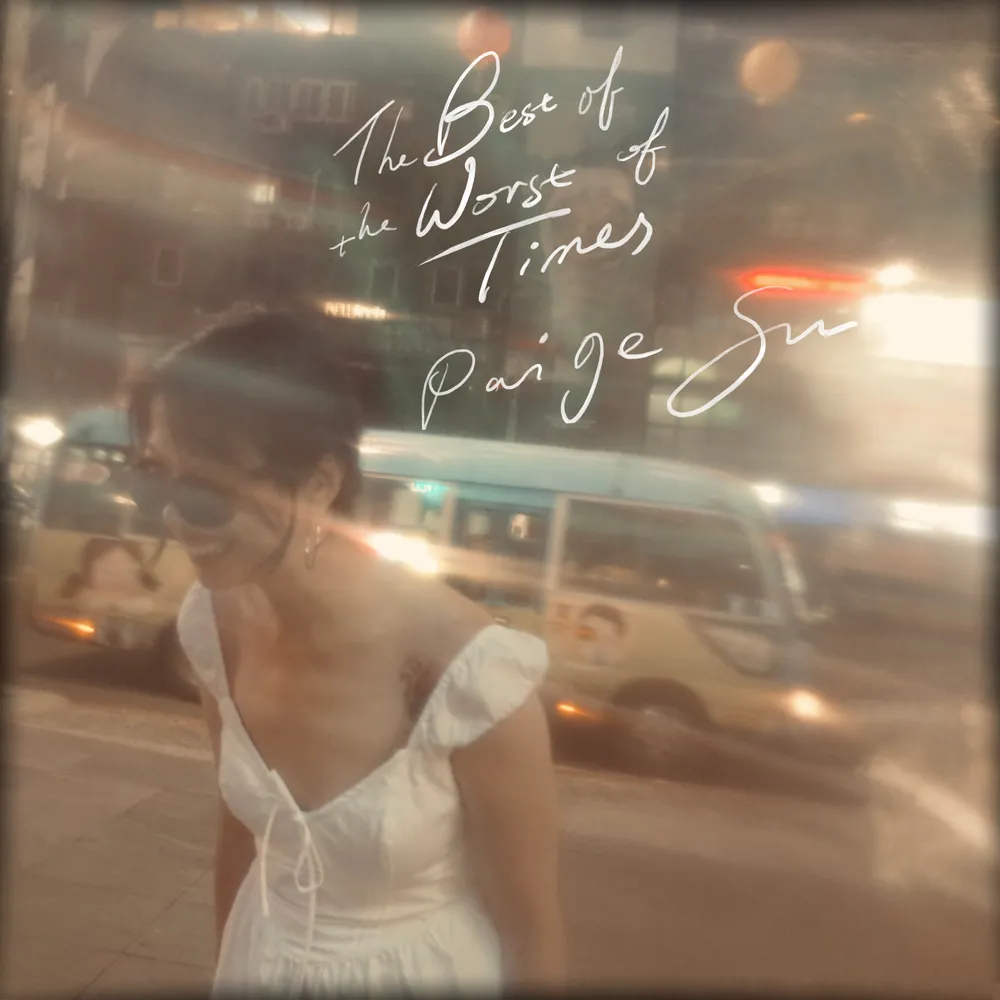
“Life can only be understood backwards, but it must be lived forwards,” said Søren Kierkegaard, the Danish philosopher who most understand as the first existentialist philosopher. Existentialism relates to the exploration of how one lives an authentic life despite the absurdity of everything around them. While S.K.’s ideas came from living in the 19th century, his ideas echo in and relate to life in the 21st century, where harsh noise causes confusion, where bad actors strip the future away from the young, where hard work leads not to a better life, but to burnout, loss of faith in institutions and society, and overall devaluation of the self.
What does any of this have to do with Paige Su’s new album The Best of the Worst of Times? Well, consider the times, and then consider what we might do about them. In Su’s ten new songs, she explores what it means to keep pushing forward in a world that continues to defy reason, where to find cracks of light in the darkness, and how to navigate personal pain from lost love. It’s another great work from the Taiwanese singer-songwriter, following 2023’s You’ll Live Forever in My Songs, which won her the Golden Indie Music Awards that year for Best Album and Best Singer-Songwriter.
On The Best of the Worst of Times, Su opens up boxes of memories as an introspective exercise into what it means to be alive today. Su’s style gives mellifluous vocals and understated but flowing arrangements, bringing to mind Phoebe Bridgers, St. Vincent, or Maggie Rogers’s softer work. The sound fits the subject matter of her music: The title track starts with Su turning the pages of her book, remembering her history, singing lines like:
The singing and the laughter around the fire
I miss the spark in your eyes that made you shine
And the us that made the best of the worst of times
These lines refer to the summer of 2020, a dark time made better only through seeing friends from a six-foot distance, finding safe ways to form community, and remove as many barriers between us as possible. During the global pandemic, we all tried to make “the best of the worst of times”; therefore Su’s song hits close to home, with the final breakdown of the track sounding like a fly-by film montage of memories might look.
Su’s songs on The Best of the Worst of Times go further back than the current decade, however. On the new record, she explores the past twenty years of her life, picking apart tattered romances, bad habits, and disassociation in the present age. “Repeated Stories” includes electronic sounds that imitate the ticking of a clock in order to symbolize this revisiting of history; it also features some vocals giving off vibes of Kate Bush.
“Letting Go (and Getting Let Go)” includes literary, musical, and religious references, such as Shel Silverstein, Fleetwood Mac, and the story of the Battle of Jericho. This literal walk through cultural history leads to the past on a personal scale: “Get dressed and go to school / Coppertone on the Golden Rule / All I ask is don’t do what I would do / Then there’s no one to disappoint you.”
While the album’s title refers to “the best of the worst of times”, some of its songs focus more on the painful moments, such as “Losing and Finding”, which grapples with the difficulty of love: “Is love just losing and finding again / Like trying to light a match in the rain?” It is a gripping track, with some symphonic elements that really grab the heart towards the end. But where Su examines getting left behind on that track, “Rally Cry” twists the introspection around and forms it into an attack against the person that left her: “But after all these years, I can’t help but wonder / If I’m just another way to leave your past behind / And tell yourself you’re stronger now.”
Where Side A of the album dipped down into the emotional trenches, Side B showcases the lifting of the spirit, or at least the gratefulness for being able to live another day. “Breathe Again” and “Thank You Life” lead into the bilingual track “After All These Years 小目標”, with the Chinese “xiǎo mùbiāo” translating to “small goals”. It’s about taking the thankfulness of being alive and realizing that it’s time to put the wheels of progress in motion in order to make the most the time that’s left. Once again, the clockwork-sounding beat returns to symbolize the seconds passing in the present. Translated from the Chinese part of the lyrics, Su sings:
In the blink of an eye, more than a decade has passed
I had created the story I was trapped in
How much time did I lose
The final track “Reunion” features Su’s original vocals from a ten-year-old voice memo over a wavering piano; both elements come together to sound like a memory uncovered on a lost cassette tape. It acts as an ode to everything that’s faded away, while Su remains behind: When I close my eyes / Still remember your face / Just a fleeting reunion now / Someday I’ll reach your place.” It’s for those who may not have made it through the worst of times, but made it possible for Su to find sparks of light in them. It’s a fitting and wistful close to the record, as Su puts away the memory box for another time.
However, one Chinese-language bonus track tacks on a little bit of extra color: “Daily Humor” touches on the changing of the world around us. Su and Taiwanese rapper DJ Didilong partner to comment on restaurants that no longer feature their favorite dishes, songs from artists that have faded into obscurity, and anything else they love getting overlooked and taken down by society. It’s a comment about not living life too seriously, that things are bound to change and offer new opportunities. The track also features other Taiwanese artists, such as drummer Cody Byassee, keyboardist MUSA Mingus, and bassist Jack Ko. The collaboration shows off Su’s more playful side, a breath of fresh air after ten haunting and deeply heartfelt tracks.
The Best of the Worst of Times is another great feat from Su, showing off her continued growth as a songwriter and her ability to craft works that are both musically adventurous and deeply human. The album acts as a reminder not to get too wrapped up in the noise of the world, to try and hold on to the good things that make us who we are, and not to let the horrors and absurdity of life drag us down into despair, causing us to forget how to live. I’m sure Kierkegaard would have appreciated this album quite a lot.
Su’s credits include vocals, lyrics, composition, piano, harp, flute, synths, and drum programming. The album also features Son Lux drummer Ian Chang, Will Graefe (Maya Hawke’s musical director and guitarist), Mason Stoops (guitarist for Phoebe Bridgers, sombr, and Jenny Lewis, among others), and Arc Iris keyboardist Zach Tenorio-Miller. Su traveled to Los Angeles to co-produce the album along with Benjamin Lazar-Davis (Okkervil River, Cuddle Magic). The cross-country collaboration and support from international musicians makes The Best of the Worst of Times a truly universal work.
Take a listen to “Losing and Finding” from The Best of the Worst of Times below.
Written by Will Sisskind
