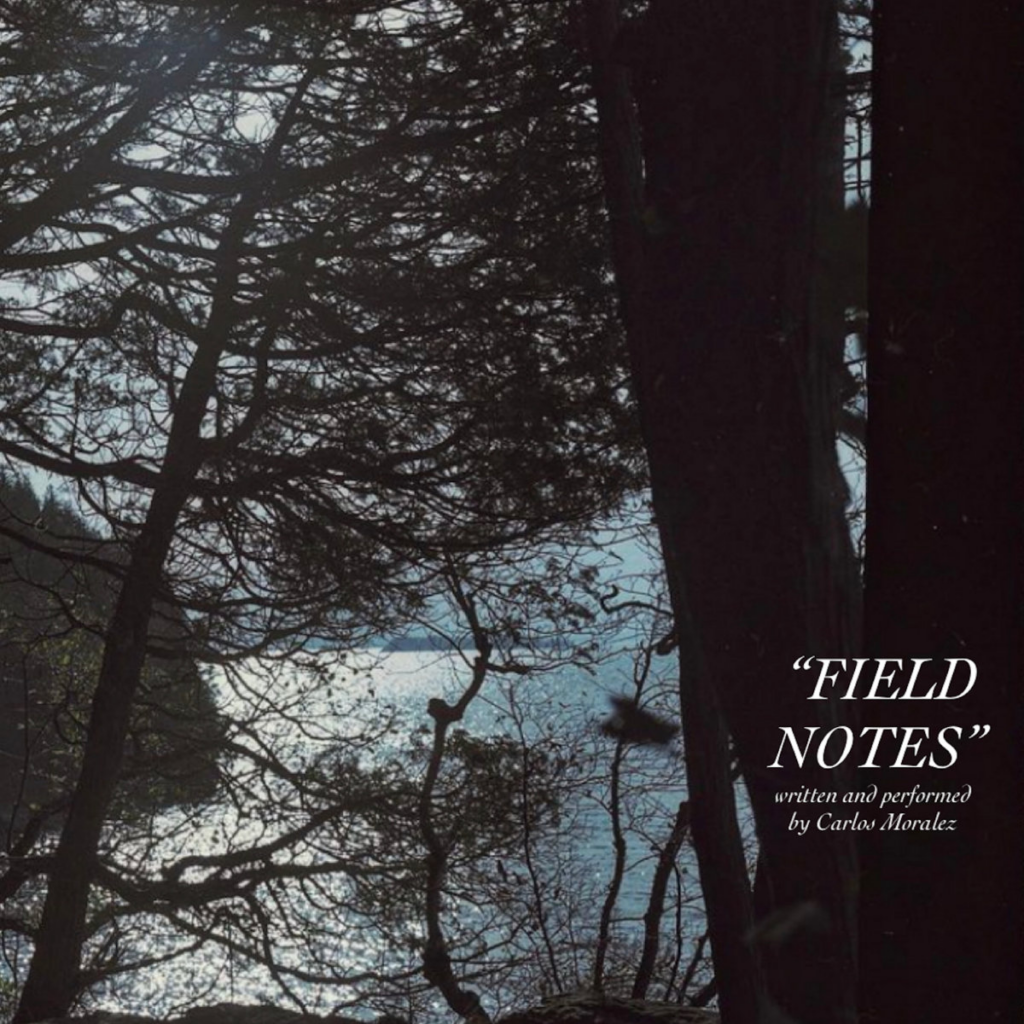
Often I find myself struck by music that I can only classify as “defiant”. The songs exude a high level of quality but eschew popular genre, time limitation, instrumentation, structure, and any other element that might appeal to a broad range of listeners. Works that come from great patience, musical care, and spiritual influence tend to fall into that category. And every once in a while, it behooves me to highlight one that moved us here at Start-Track.
Today, that work is Field Notes by Carlos Moralez, a multi-instrumentalist and songwriter hailing from Los Angeles. Moralez has made music since 2015, and has spent the past three years materializing the songs featured on Field Notes. They have followed him not just through time but space, taking shape across several places Moralez called home.
Like true field notes from a researcher, Moralez’s album documents his findings on love and death, sharing them in abstract lyrics and ethereal musical arrangements. The result sounds like a child born from ambient, spoken word, experimental, and jazz influences, swinging in a bassinet from which Moralez’s voice creaks. The music incorporates natural sounds – field recordings – such as birds tweeting, children shouting, crickets chirping, and room tone from a variety of both indoor and outdoor environments.
Field Notes demands rumination: It does not provide the kind of easily-digestible three-minute indie pop to which one can bop their head. “Traveling Light”, for instance, swells and glistens with electronic sound, while Moralez sings in almost slow motion, like a disembodied voice over the droning overtones of the turning of the world: “I scattered my soul / The severity shows / Like everything else that goes.”
Moralez takes on a similar vibe to Sigur Rós, even naming one of his songs in Icelandic. “Himnaríki”, which means “kingdom of heaven” or “paradise”, describes the feelings of someone in their final moments remembering everyone who left the mortal realm before them. The track runs for almost fourteen minutes, mostly containing a musical refrain made up of chopped vocals, soft synth pads, and the occasional effected piano. It feels like much more than the sum of its sparse parts, like a meditation for those seeking peace from pain. At the end, Moralez sings, “So just hold on to those you love”, solidifying the song’s vibe as the final moments of clarity of someone who is dying. The voices are coming down from the heavens: Life’s final lesson is to love.
Other artists feature on Field Notes, not just in inspiration but in poetry. David Berman of Silver Jews (and of blessed memory) appears on “Self Portrait at 28”, the first track on the album, which is named after Berman’s poem. Fellow musician Leila Grillo reads an excerpt from the poem at the track of the track, which is otherwise a soft guitar instrumental. It makes for a compelling introduction to the record as well as a thesis for the songs that follow. If I may republish that excerpt here:
“It is a certain hill.
The one I imagine when I hear the word “hill,”
and if the apocalypse turns out
to be a world-wide nervous breakdown,
if our five billion minds collapse at once,
well I’d call that a surprise ending
and this hill would still be beautiful,
a place I wouldn’t mind dying
alone or with you.”
The album’s final track “So Long” closes the album with a conversation on an answering machine and a seven-minute mantra regarding acceptance of death, which in itself is an act of love. To leave the dead to die, the song suggests, allows freedom for the dead and for the living. Of course, the dead must remain alive in memory. But on “So Long”, Moralez sings from the viewpoint of the dead or soon-to-be dead, allowing the living to continue on with their life. The song also feels like one for a final breakup, which also suggests something dying but allowing for two souls to live on. Regardless of the meaning, the song’s sadness stems from Moralez’s deadpan singing, the whistling wind prevalent in the recording, and the occasional harmonica over the repeating and echoing guitar refrain.
Field Notes is not an album for those looking to bop their head or have a good time. It commands the listener to sit down, appreciate the album in full, and derive their own thoughts from the rough research Moralez has compiled over the past few years about love, death, and personal growth. Because of the rawness of the recordings on the album, you can feel every emotion and imperfection: The songs have undergone no sterilization or overproduction: In fact, any editing done to the tracks further amplified their authentic nature.
Confessions and reflections make up this gorgeous piece of work from Carlos Moralez. For anyone trying to connect to deeper emotions, Field Notes is a gem worth your time. For anyone who wants to shake ass and vibe, you might still consider Field Notes. You might find it a challenge to shake ass to the music, but with the right attitude, I think you can manage.
Take a listen to “Diving Bell” from Field Notes below.
Written by Will Sisskind

Incredibly grateful for this lengthy and detailed analysis on the album! Thank you! Will has made me see the whole thing in cool new ways. Love y’all! 🙏
Thank you!