Listening to Collected Ghost Stories by Andrew Van Lennox tangentially takes you back to that J. G. Ballard quote that went, “I wanted to rub the human face in its own vomit and force it to look in the mirror,” but this attempt at that kind of forceful exposure is a lot more abstract and cerebral than J. G. Ballard’s in-your-face style.
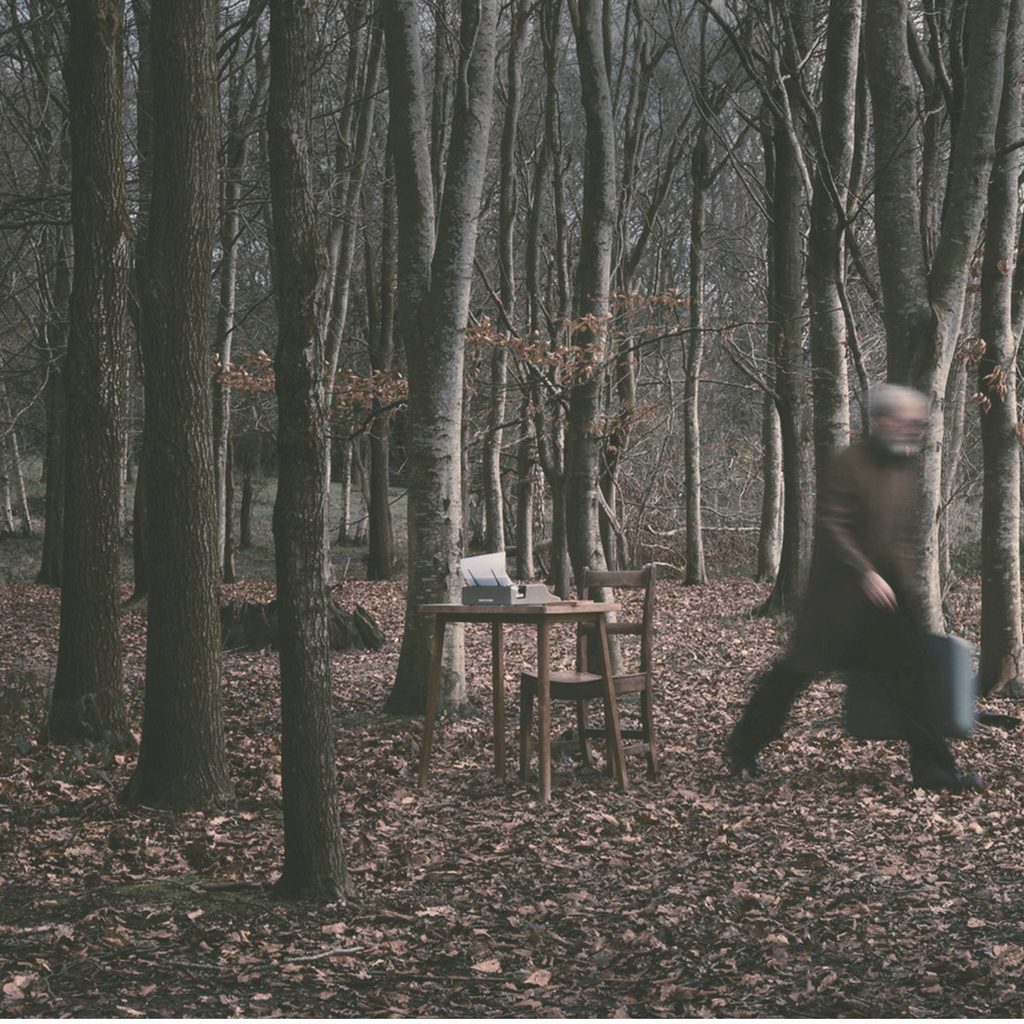
But to this point, everything on this record, from the cover to the instrumentation and lyrical content, is meant to put you off. On the cover, there is a man captured in motion, ostensibly leaving a desk with a typewriter on it and, get this, all of this is happening in the middle of a nondescript forest. It is anachronistic and alienating, but at the same time subtle enough that you might not even notice the oddness, the absurdity, and just take it as it is because in our world, the post-post-modern world, nothing could look out of place and everything can travel in time.
The record opens with Harpsichords At Dawn, and immediately the dingy, fuzzy, reverberating sounds introduce you to the kind of eerie listening experience you have signed up for. The percussion stalks and creeps closer and closer like it is planning to hunt you. “Nursery dolls – eye glass,” the imagery that is splayed out is harrowed, haunting, nightmarish.
“The trees are all fingers / The trees are all thumbs,” he flexes the distance between you and the understanding you could form of the words with reiterative grotesque personification. But here, the trees are fingers, and they’re all thumbs, and without thumbs, the rest of the fingers wouldn’t be able to hold much or do much, so this reads as an environmentally conscious comment. And still the percussion stalks you while the slow plucked guitar notes coil around it loosely.
The images are back-to-back, jumbled, and rapidly changing. This makes this record not seem like a story but a series of observations that have been melded together, come to be because of dulling social aggravation. This sounds too webbed and scaly for a story, too kaleidoscopic. Let this first song slither over you. For me to explain it further would be to try and recreate it in a less arresting way, so let us move on.
Collapse of a Dead Star starts out with a more thinned-out, barbed, and buzzy guitar. But it still adopts that preying-on-your-ears element of the sound when the bass joins in. The stream-of-consciousness writing is referential on this one: “Havisham wedding cake,” referencing the character in Great Expectations by Charles Dickens who is left at the altar and thus now sits in her mansion all alone save for her daughter figure, surrounded by decayed wedding cakes and candles and a frayed wedding dress. This serves as the crux of the record’s messaging: we are all waiting. We are all wasting time, trying to undo the unraveling of the spool of time.
“Ice cream tongues around sensational details / Hungry for gossip and sin,” is an indictment of the shallow treatment of the truth and the gratuitous focus on the peripheral, the attempt to reassemble a truth with conjecture and self-serving narrative.
On Waterloo Teeth, you find that nonsense is not nonsensical. It is, in actuality, truthful. It is not contrived, to say the least. “You are old and full of days,” conjures a picture of the man on the cover of the record. Old, full of days, having written what he means to say in any way that it decides to come out, packing up to go and maybe return to his work tomorrow. Maybe not. You cannot be right or wrong about what this album amounts to; Andrew Van Lennox makes sure of that.
Sea of Vapours contains the lyrics, “Lies across chairs that bear the impression / of the people that sat there and listened to clocks / Ticking minutes, and seconds, and hours,” again condemning wasting time however passively. This album skitters away from taking firm stances and instead leaves things open to interpretation, for the most part. It slips up sometimes and pours out some complaints about societal tendencies like this one.
The references on this record, the sparing use of them, the all-over-the-place quality of the eras of art they are each snatched from, lend a timelessness to this album that rejects even the mere presence of time. It traps you in a void cluttered with images, and the only reason it is a void is that the images flit so quickly and you are bombarded by them. They are shot at you, falling on you, aimed at you. Rain. Bullets. It is all the same at this point. It all hurts.
On Bungalow Ghost, the percussion picks up. It must mean that at this point in the album, Andrew expects you to be running. “No castle, no skeleton, no family curse,” bestows an image likened to The Fall of the House of Usher by Poe. “Just a tea towel, linoleum flickering bulb,” smushes comfort and disarray and creates a cushy kind of disturbed way of winding down. Not a contradiction, but an uncomfortable co-existence.
“And all your comfortable certainties…” You are too comfortable in your bungalows. It is time that you got haunted.
Subfusc ends with a continuous high-pitched, needling sound that at times summons the sounds of birds chattering. “Night falls like a stone in a well,” like a heart to the pit of a stomach. The night is here, and you were not ready. And the suddenness and the punch of the dark shrieks at you. That is the song.
The Downs mentions England once again, just like on Harpsichords At Dawn, and the guitar sounds mock-patriotic in the way it rises and billows out and then deflates back down like a march to nowhere. “Sediment settles all quiet like sleep, so slowly,” and “We are all broken,” are some of the most straightforward lyrics on this body of work, as if they were too important to cloak in anything but outspokenness.
“White horses roll over me…” even the stereotypical savior is sinister. The white horse that should deliver the soldier or the knight that will rescue you is actually trampling over you. Ending the album on a chilling note, you realize that the world is the sum of its parts. You cannot outlive the decisions of many. One cannot outlive many. Period. And Andrew asks for total destruction to speedrun through this slow decay caused by the many. He asks for us to be massacred by classic monsters like Grendel from Beowulf or Dracula, the bloodthirsty vampire. The album spans opinions and observations to arrive at a conclusion: let us be done. Let us be swallowed.
Maybe I was wrong. This is a story. It is just not the kind of story you want to hear. But it is the kind of story you should hear.
Written by Leo August
