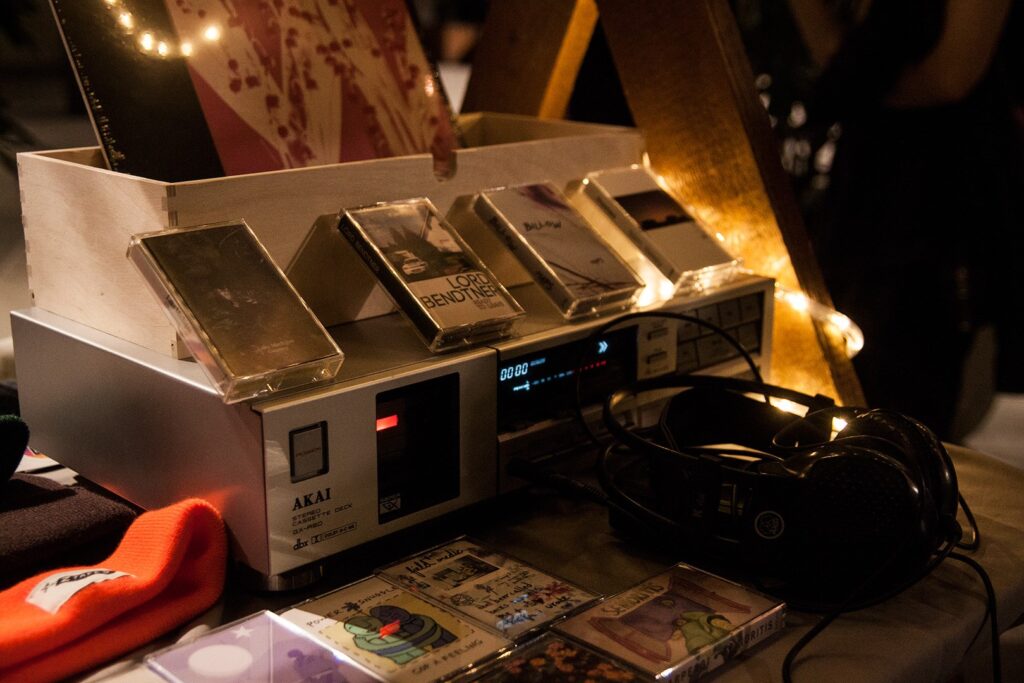
I’ve been thinking about what to write next, as there are many topics I could cover in the cassette label series. However, one question that keeps coming up in my discussions with people is about cassette players. I’m not an audio engineer or a hi-fi geek. I always bought things recommended to me by more knowledgeable friends, but over time, I tested a few cassette players and gained some experience to share. Usually, the main question people ask is: Where do I buy a cassette player?
The first obvious point is that there aren’t many companies making cassette players at the moment, and most electronics today are made in China—not all of them are of good quality. I will touch on three things: first, vintage cassette decks; second, vintage cassette players; and third, modern classic players.
Vintage Decks
The main reason people ask about cassette decks is that they want to duplicate tapes at home. I’ve never done this myself. When I started my label, I didn’t have my own place and was moving a lot, so I wasn’t really investing in audio equipment. From the early days of my label, I used professional duplication services. However, I had a friend who runs a record store in Bratislava (which I recommend visiting), and he sold me an AKAI GX-R60 deck for €50, which was a real bargain at the time. I loved it for years until it broke, and I haven’t managed to repair it yet because I have other cassette players as well.
In general, people often recommend TEAC or TASCAM cassette decks because they were relatively cheap for the quality they offered. Of course, this always depends on what’s available around you. Prices for decks have gone up, but you can still find them cheaply on eBay, at your local secondhand store, or maybe at a thrift shop—whatever is popular in your country.
For example, in Slovakia, we have an online secondhand store similar to eBay, where I found a lot of cassette decks for a good price, though you usually need to pay more for good quality. I know of cassette labels that used to have a couple of decks and did duplication at home, but didn’t have a duplicator for making multiple copies at once. It always depends on what quality you are aiming for and how much budget you are willing to spend on a cassette deck.
There’s always the option to repair or refurbish a deck, and that’s what I’m planning to do with my AKAI, as it has really good components. Some electronic components are deteriorating over time and need refurbishment. I don’t have any specific type to recommend as a must-buy, but I do have a nice recommendation that I’ll share at the end of the article.
Vintage Walkmans or cassette players
One thing I would recommend to anyone is to start with a small Walkman. Sony was always the best brand, and if you’re lucky, you can get a Sony cassette player for a good price. Both high- and low-quality Walkmans are available. Some of the cheap Walkmans were really poor in sound quality, tended to eat tapes, or had other problems. Usually, the belt that powers the mechanism breaks, leaving the Walkman inoperable. It’s not hard to replace the belt, but getting the right size for the cassette player is a little harder. There used to be some suppliers who offered replacement belts, and it was pretty easy to fix. Try to Google belts for your brand and model, and maybe you will be lucky.
For example, I was able to get a bunch of Walkmans at a flea market for a very low price, as a lot of people were getting rid of them. High-end Walkmans from Sony are really pricey now, but they are worth the cost because they are of such good quality, and you’ll love them. I have one at home and can tell you the quality is much better than any cheap Sharp or Panasonic cassette player.
Unfortunately, Sony is no longer making Walkmans, and the technology is gone for now, so your best bet is to find a used one that was well-maintained and in good condition. Again, it depends on what’s available in your country and what kind of secondhand options you have. Sometimes you need to do a little research—thrift stores, flea markets, garage sales, or secondhand markets – are good places to buy a Walkman.
Alternatives to Walkmans are standard boombox players or players with two tape slots and built-in speakers. For example, I have a Panasonic RX-DT37 at home that has great sound and is pretty sufficient for playing tapes. I think they are not priced as high as some of the high-quality Sony Walkmans, so that is another option when deciding what to buy. The advantage of Walkmans is that you can put them in your pocket, clip them to your belt or backpack, and carry them with you even when traveling.
Modern players
Now we’re getting to the fun part: modern cassette players. I wish this were a topic we could spend hours on, but at the moment, there are two brands I would recommend. One of them is We Are Rewind, a French company that I supported during their Kickstarter campaign. I received one of the first Walkmans they ever made, and I love it. I’ve even lent it to friends, and they’ve enjoyed listening to tapes on it.
I haven’t seen many negative reviews about it, except that the cassette mechanism may not be as good as it could be. But in the current situation, where there are no big manufacturers of cassette players, an acceptable level of quality is actually quite good. When I compared it to other decks or older Sony players, I didn’t find much difference. One of the best things about We Are Rewind is that it has Bluetooth and a lithium battery, so there’s no need for AA batteries—always a downside with old Walkmans, as you needed to replace them quite often.
Another great brand I recommend is FiiO. I don’t own one myself, but I’ve heard it’s actually very good—comparable in quality and price to We Are Rewind. They also offer a nice selection of colors and claim to have high-quality cassette heads, which is always the most important part of a cassette player for sound quality. Unfortunately, they only have a headphone jack, but Bluetooth headphones aren’t strictly necessary, as you want to go analog either way.
We Are Rewind Boombox
One thing I want to mention specifically is the new boombox, or ‘Blaster’ as We Are Rewind calls it, which is a tribute to the old, big boomboxes that were quite popular with the hip-hop community in the early days. I don’t own one because the price is a bit higher than I’d prefer, but I’ve considered buying it because it is not only a great cassette player; it also has great speakers and can be used as a Bluetooth speaker. You can even record directly to cassettes with it, and I really love the design. If you want something that looks super cool, delivers good sound quality, and can double as a Bluetooth speaker, this is your choice.
Future of players
When I started my label, there weren’t many opportunities to buy modern cassette players. The only option was vintage players, which were still a solid choice. But now, the fact that you can buy brand-new models with a 2-year warranty, cool colors, and new features makes me very hopeful that cassettes won’t disappear anytime soon. The biggest problem used to be the lack of cassette players, especially in recent years, but brands like We Are Rewind and FiiO have solved this and brought a bright future for the cassette medium.
Of course, the prices are higher these days, but considering that even phones cost more than half your salary, depending on where you live, buying a cassette player for a higher price should be worth the investment. The quality is really satisfactory for a pleasurable analog listening experience, and hearing that warm, crackling sound of tapes is something I love very much.
I always enjoy my time when I put a freshly duplicated tape or a newly purchased tape from another label into my cassette player, turn up the volume, and get lost in the sound. At this moment, anyone who wants to be a cassette fan can do so. It’s not as cheap as it used to be, but a lot has changed since the ‘90s, when cassettes were the cheapest medium. Cassette players are still affordable, and the future of the cassette medium is much more promising than it was ten years ago.
Buy one
So if you don’t own a player, I hope this guide helped you decide which direction to take. If you have the time and money, you can try multiple cassette players. If you want to try just one brand, I definitely recommend We Are Rewind, as I have loved their products and appreciate that they’re trying to bring back the momentum for cassettes. I’m ready for it!
As we continue this series, we’re always answering your quick questions regarding cassette labels, and this was one of the topics I wanted to cover. I have at least ten more ideas I want to write about, and I’ll cover them in the next series. I’ll be breaking down everything I’m doing with our cassette label so I can share my knowledge with as many people as possible. I feel there’s always room for new cassette enthusiasts to emerge and appreciate this lovely medium.
If you have some tips for cassette players or questions to consider in the future series, just let us know.
If you enjoyed reading this, consider buying a cassette from us to experience the music we selected and also support my mission.
Read previous posts:
Written by Filip Zemcik – mastermind behind labels Z Tapes and Start-track.com

1 thought on “How to Run a Cassette Label #3: Which Cassette Player to Get?”