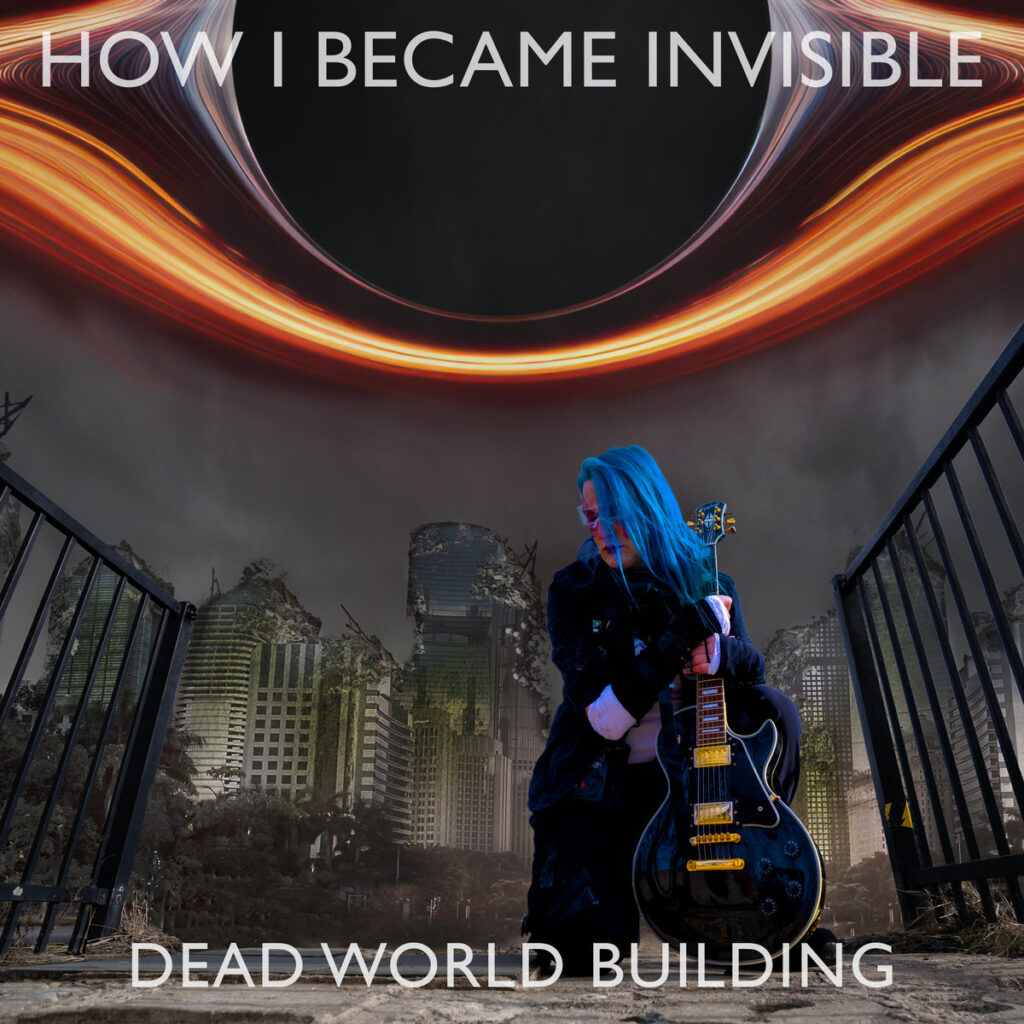
Two of our Start-Track writers took a liking to How I Became Invisible’s new album, Dead World Building. This is Gimp Leg’s review: Click here to read Christian’s take from earlier this week.
How I Became Invisible is a soulful emo band out of Philadelphia, Pennsylvania led by Emily Reed. While I never listen to much emo, Emily’s music has always reminded me of a sad, but wishful diary set to an emo soundtrack, with occasional dreams of space and science and fantasy. A long and unwilling disappearing act in a stage play where she is the lead character but is experiencing the script in real time, like The Truman Show with a tragic ending being foreshadowed, but unrelentingly fighting to keep the show on the air. In Dead World Building, if the show is gonna end, it’s not going out on its own terms. There is a lot of sadness, but there is a lot more fight.
While her first EP came out in 2009, there were only two albums in the first decade. However, since 2018, she has put out new music every single year, and everything from song composition to sound quality is continuously improving.
When I write album reviews, I always review the first song. (I try to never review each song on the album, just the main peaks and themes). I feel like the first song is the tone-setter for an album, and most bands choose one of their singles to begin the album. I’ve always been a fan of album structure. Even when the first song isn’t one of the best songs on the album, it sets the tone for the listener.
Dead World Building begins with “Dead Astronauts Pt. 1” a lo-fi heart breaking song with just vocals and a quiet piano over the crackle of a record. The song has the feel of isolation and a desperate plea. It’s just over a minute, and it doesn’t sound anything like the rest of the album, but it does everything it is supposed to with beautiful expertise.
While “Dead Astronauts Pt. 1” was the actual first song, “Prompt Critical” is the pace setter for what the rest of the album is going to sound like. Instrumentally, it’s harder – an aggressive emo – with thick bass, and vocally it has a longing and sadness. There is a nice complexity playing under the vocals that draws me in, layered vocals that get intentionally drowned in the background create an amazing effect throughout the song, and keys that add a beautiful texture keep my attention. The vocals are in the forefront, but my ears are only drawn to the subtleties as the song begs me to feel its meaning instead of hearing it.
“Mosh Pit in the Wawa” has more grunge and rock vibes, but is surprisingly optimistic. A song about surviving and moving on, with a chorus that plays really big and beckons your attention. But as good as the chorus is, it’s the distorted guitar solo that steals the show. The distortion is gross in the best way possible, and as the solo ends we are brought back to a clean, solo, stripped down repeat of the chorus with they “cutting you off like a phantom limb”. The chorus rises, back up, building aggression, as the chorus repeats and closes “and I’m stronger than I thought I’d be”. The way the tone of the final chorus matches the lyrics is perfectly fitting.
“We are (Not) OK” is my favorite track on the album. It’s a little slower and fairly direct. Musically, it’s simple, like a radio friendly pop song: The rhythm is kinda catchy, but it is really structured to let you focus on the lyrics for the first half of the song before picking up in tempo and aggression and filling in with “whoa-ohs” for the second half. The song is about patriarchy and trans struggles in a world hell bent on denying access to care. This is just a simple and beautiful song.
“Harley and Ivy” is probably the most unique track on the album: A beat driven mostly by drums where the guitars are distorted a little. It feels like sounds as opposed to notes. A voice reads below the sound of the music, drowned, passionate but not rising in tone. Not with rhythm, not singing: It is the sound of resistance, programming a generation of warriors to rise. A reading of grievances and inspirational commands under the steady beating rhythm. It is a call to action: Try to remember who you are. End transmission.
Side 2 begins with “Dead Astronauts Pt. 2”. Pt. 2 picks up where Pt. 1 ends, but with hope. We are not gonna die for you! Take anything you want but you won’t take the heart from me. This leads directly into “Temporal”, which is the most upbeat and optimistic feeling song on the album. Lyrically, the song is full of longing for the world to change and impatience, but there is a feeling of hope and camaraderie. It gives the mixed signals of being frustrated with things you can’t change, but the knowledge that you are with the people by your side that will try anyway.
“Kenopsia” brings even more fight to the album. It touches on depression and mental health struggles but it has a big powerful chorus: “I’m not afraid of the future, I’m just afraid we’re not all in it together”.
One of the most important aspects of music, in my opinion, is community. I mostly write about ska, and the ska scene is often very community oriented. Whether it is the ska festivals around the country that brings listeners together, or bands collaborating with other bands. The entire two-tone movement has some roots in building community. Omnigone, and their predecessor Link 80, have their “Against the Rest Crew”. Bands like Jer preach the importance of community from the stage. J Navarro and the Traitors have a song titled “Community in Collaboration”. Any music that is rooted in justice and resistance to oppression needs to also be rooted in community. To quote Space Monkey Mafia “None of us is better than all of us together”.
Those themes flow through Dead World Building in a special way. It’s not just community, it’s world building. The album is full of a deep passionate love for a chosen community. It’s built in resisting oppression, and holding people to your heart and loving with every fibre of your existence. How I Became Invisible isn’t a disappearing act: It’s a survival guide for a community.
Take a listen to Dead World Building and follow How I Became Invisible on their socials below.
Written by Gimp Leg
