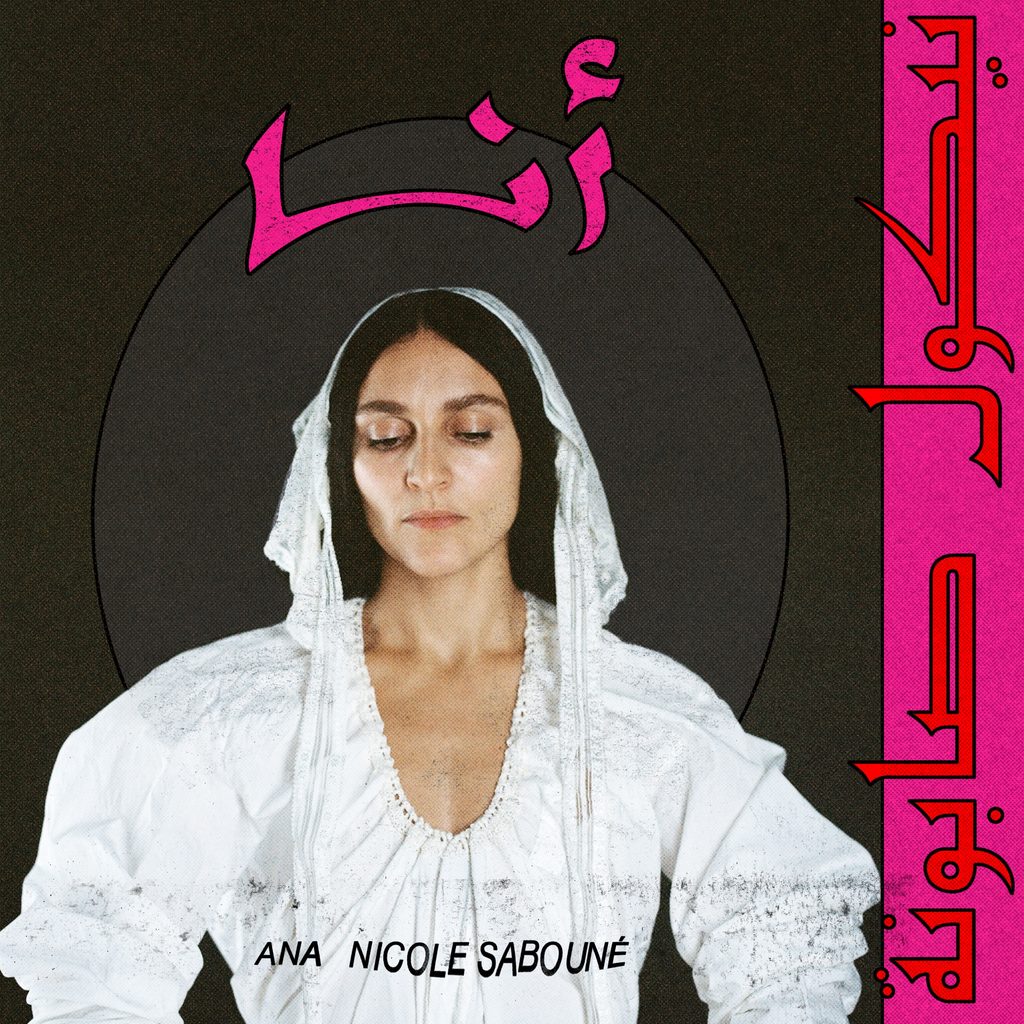
What Nicole Sabouné poses at the beginning of ANA – meaning ‘I’ in Arabic – are questions. “Where do I come from?” is the most striking one. And when questions are proffered, what usually follows is a sizable trek that culminates in the answers. This time, answers pertaining to the foundations of her identity. But what if in the process of answering the original questions, you unearth even more questions? What if an answer isn’t enough, and what if asking is just a way of announcing how you are feeling? What if the questions are just a way to be heard? And what if nobody does?
On the eponymous opener, ANA, the percussion sounds like the drums and bendir (بندیر) played at the annual, traditional, and religious custom of the procession that is held in honor of Imam Hussein’s martyrdom on Muharram. Even though it is propulsive and strident, even raucous, it sounds like a dejected, heads-hanging-low march forward with a paradoxically steadfast gait. A trudge that needs to be done to get to the end. The lyrics make it obvious that this is an uncertain plight – with the unsure explorer not knowing where she’ll end up, like an adventurer that sets out to find a new land – towards excavating a sense of identity that is as unwavering as the conviction to find it is. “Please take me on / Make me sane.” There is a lot riding on the outside world to determine if she belongs to any part of it. This is a call of uncertainty. “I need to be brave / Take a stand.” This is where the decisive steps forward stem from. The tenacity. “The beautiful streets of Beirut / I am calling you.” Her vocals drag, sprawl, and linger here. She is calling out, calling into the ether.
The second song, Lubnan, sounds more like bounding forward. A more vigorous pep in her step. She is boundless. Lebanon might be the answer. She is screaming. She is rejoicing. Is this freedom? “Now I know the place to be free.” But this is just an assumption, and she knows that “dreams / They are never what they seem,” And this could be another one of those dreams that “never end up happily.” But for now, the dream is still a dream. And that feels nice. She revels in it, “La la la, Lubnan!” Her vocals are untethered, and the ether she was calling out to? She has joined its weightlessness.
Leave It All Behind changes course. A ballad. The drum beat follows the cadence of Nicole’s vocals, the quickening and slowing down. “I don’t know if I’m mad or lost.” Looking inward, she finds jumbles of thoughts, unable to untangle them, to compartmentalize. A lament about her family’s neglect and simultaneous belligerence. “I wish I wasn’t there.” “When you stay far away, I’m okey.” Part of her distance from her identity is her distance from her family, which assures her peace of mind while also defining her alienation from herself. With no love extended to her, she was too busy coming to terms with being on her own to know who she actually is without factoring in that abandonment.
The guitars on Mirror On the Wall suggest a story incoming. An unraveling that is almost spoken-word at some points with shoe-gazey instrumentation. “Everything makes me confused / A mix of different truths.” She knows a handful of truths. She just doesn’t know which one is true enough to hold on to. “Not resist / I actually come from here.” It is actually scary for her to admit that she actually belongs somewhere because it is the one truth that she wants so badly to be true. The one she chooses. There’s a motif of asking for some kind of interference from the outside world in rapid-fire screams. She seeks that interference out in company and art. She listens to Fairouz, an iconic Lebanese singer. Nicole is from here. She belongs to all the landmarks of art and passion.
On Hadia, someone in her family from Beirut warns her about the political climate and calamities of the city, but also leaves the decision of her going there up to her. Gentle, kind, and careful. She is not coming to Beirut; she is coming for Beirut. For its freedom. For its salvation.
Beirut is a short song, rhapsodizing and mourning for Beirut. She says, “I am the dream,” as opposed to before when she just had dreams of belonging. She belongs to herself and her self belongs to Beirut. She says, “Take me on,” again here. But this time, she is actually here, on the soil. The striking opening tempers down to more threadbare vocals on the verses. Beirut is precious. She won’t accost it.
The Arabic title of Light for Us translates to A Better Future. The beat is determined. This is the most assertive and sure she has sounded so far. This is an anthem of hope. Sunlight at the end of the row of burning buildings. The sun will come up over the wreckage. All will be well. “No resilience but peace.” Someday, they won’t have to be strong in adversity; they can be content in alacrity.
She says, “Free in any way / Never feeling scared,” on Healing You, followed by a mantra of “I feel like healing you.” She feels recovered enough and recuperated enough to want to heal someone else, to heal Beirut. Her vocals and the instrumental move forward ever so slowly, approaching with caution so as not to spook. The latter half of the song is preceded by a violin played by Nicole herself that transitions to a reiteration of the sentiment. She is desperate to heal and be healed, to be free, to be unencumbered by fear. She is shouting it to someone rather than into the ether this time.
So Far Out is the most energetic, kinetic song of the album. She’s found the answer to not feeling lost is being home. Being in love. “And if I know myself, it’ll never go away.” This is an epiphanic summit on the album. Once she has a grip on who she is, she’ll never let go of it.
Dad’s Poem translation:
What can one say about Lebanon?
You know I miss you.
It’s been such a long, long time.
I haven’t seen you, Lebanon.
I remember how you used to be.
How you were before they ruined you.
Before they struck you,
Before they plundered you and left you dazed.
I remember how you were before the war.
The image remains forever in my heart.
The war that drove your children away.
The war that shut your doors.
May you return to how you once were.
I dream of you, Lebanon.
And in my dreams, you are the most beautiful of all lands.
I miss you, Lebanon.
It has been such a long, long time.
I Don’t Mind is the closer of the album, and what closes out the album is a gentle landing on the ground. “I don’t know what is, what is true.” Where is she? Who is she? What’s outside? What’s on the inside?
She wanted answers, but in trying to find them, she drew from beneath the ground, from the smoke in the sky, even more questions. She may know where she feels at home, what she wants to fight. She may even know where she comes from. But what she doesn’t know is… where does all of that come from? We may never know. At least, not before she does.
For now, all we have is this album. So let’s listen to it here:
Written by Leo August
