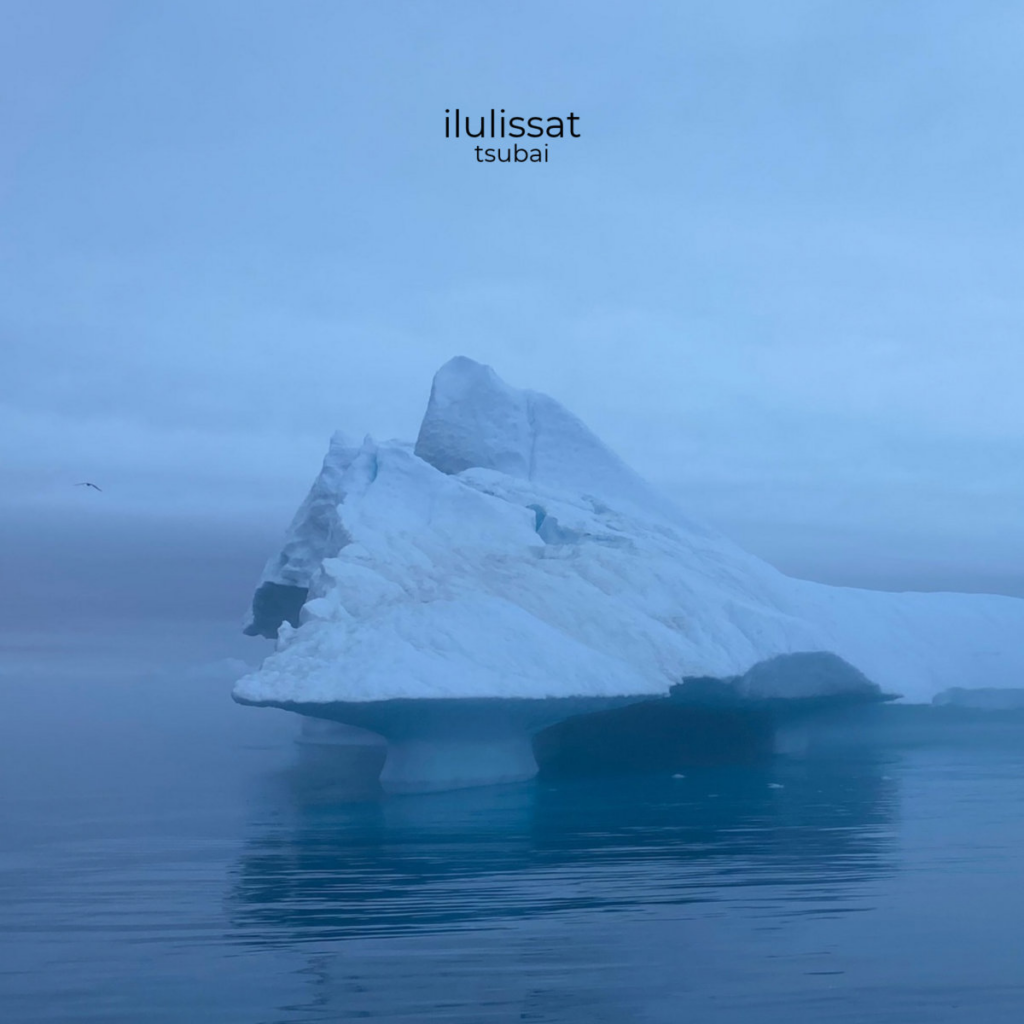
ilulissat – named after a town in Greenland – captures the life-cycle of ice from its formation and growth to its decay and ultimate demise. It is the result of musician Matt Teffer’s journey to the Arctic Circle in July 2025. The album takes you through a portal and into an alternate world that is untouched by humanity, and it suspends you right in the middle, surrounded by curtains of sound. You keep pulling them aside, but they are never-ending and keep appearing. And you float through dimensions, exploring a dream-like world.
There is little to say about what the album tells you, but a lot to say about the way it makes you feel. It sounds exactly like what a stream of consciousness would sound like. But before we dive in, the story of this project – apart from the music itself – is equally told in the song titles. So this review is best told semantically.
“Accretion” (the process of growth by a gradual buildup)
The first track on the project starts slowly and then grows into a drowning sound. It ebbs and flows and has a progressive quality, and feels like you are on a ship surrounded by silence making your way through a thick wall of sound. Nothing matters or makes sense, but this ignorance is not chaotic. Everything is in perfect harmony with everything else. Horn-like sounds appear as signals through the darkness before the song fades into nothingness, like a ship vanishing on the horizon.
“Striation” (a minute groove, scratch, or channel especially when one of a parallel series)
This song is like a waterfall, with several streams falling at the same frequency and the resonance creating something surreal and world-altering. There is a single sound that pitches high sometimes, keeping you moving forward. But the hypnotic sounds of the fall persist and pull at you.
“Ablation” (loss of a part – such as ice from a glacier or the outside of a nose cone – by melting or vaporization)
Characterized by the grief that comes with the beginning of decay, this track sounds like the wailing of some giant prehistoric creature, most likely the glacier itself. It builds and inflates, but the wail remains constant behind all of it. Different layers of sound first weave together into one and then slowly break apart, coming undone.
“Sublimation” (to pass directly from the solid to the vapor state)
This track is lighter in weight, with sounds bubbling and passing into thin-air. It swells and swells and you wait for it to burst, but it kind of slowly gives way, fizzling out. You can tell that there is something transformative happening far away, a kind of sound you would hear from an industrial process, reaching you through miles of air.
The two longer pieces that follow these four tracks are named after places rather than things or processes. They capture the geographic reality of being in the middle of nowhere and surrounded by the all-encompassing ice.
“Sermersuaq” (the Greenlandic name for the great ice sheet of Greenland)
Meditative and constant, “Sermersuaq” has a droning sound, as if you are flying close to the surface of ice to inspect it. There is a little hoarseness too, and it is so pliable that you can almost hear anything you want to. There is a blur between what is objectively there and what could be a product of your mind. For nine minutes alongside the track, you explore this location, experiencing the turns and the pathways. Eventually, it builds into a hypnotic place where time and space do not make sense.
“Sermeq Kujalleq” (a large outlet glacier in West Greenland)
The sounds of this track again are full of grief: They swell, fizzle, balloon, and make you feel buoyant, as if you are about to hit a wall or ceiling.
As the project ends, you are left feeling as if you were on a voyage through a far-removed world, and are now saying goodbye to it and leaving things behind. In this way, ilulissat is a unique project – much like the place it represents – and it takes you on a journey to an icy quiet world.
Take a listen to ilulissat below.
Written by Riya
