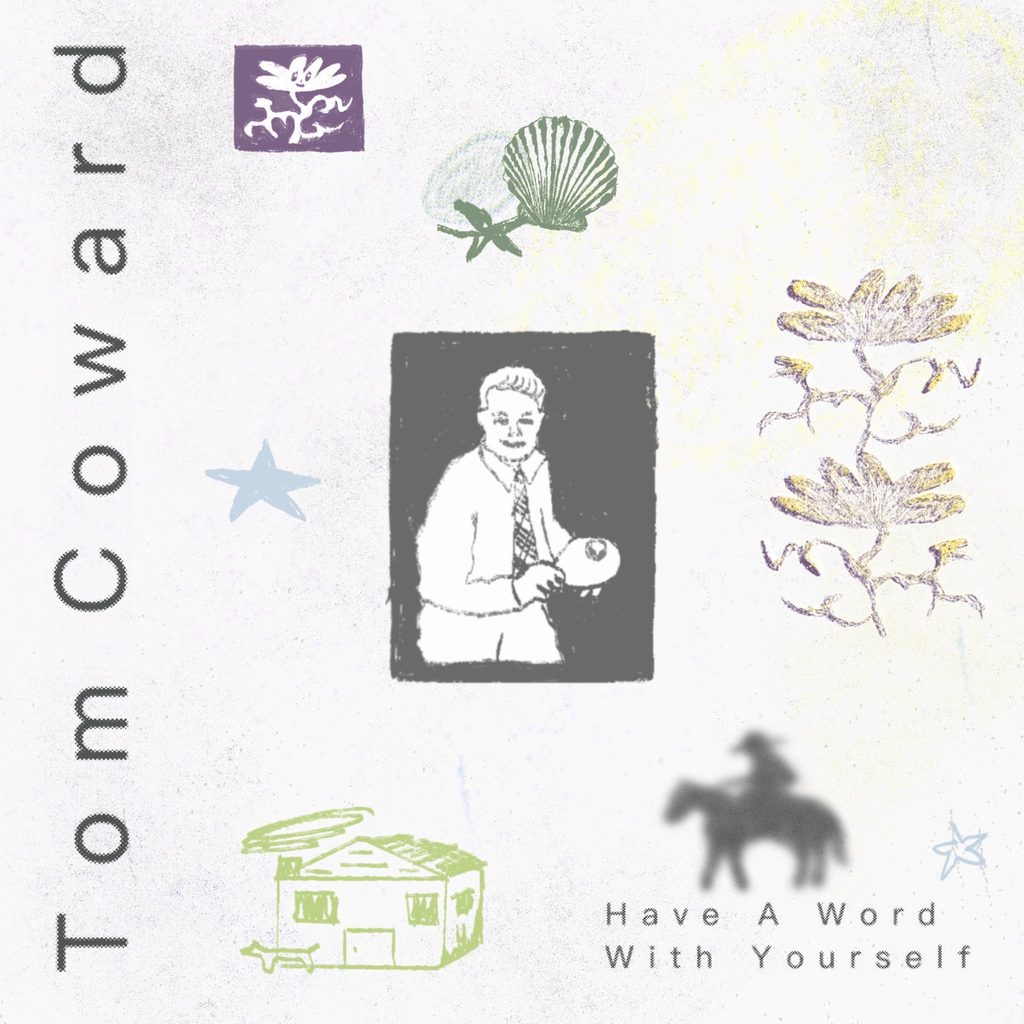
With abstruse whimsy, the first song on ‘Have a Word With Yourself’ called ‘Send Closure’ starts out with vocals that sound like echoes ensnared in a tunnel because he is permeating the song with sentiments that are emanated by a desire to find or procure closure. He wants to verbalize the fractional kind of closure a person can cajole from another person in this modern world of disconnect and divergence with the staccato delivery of snippets of thoughts. ‘Send Closure’ is painfully relevant because it is a slew of messages; interstices of concern, reminders behind decimals of radio silence. The instrumentation progresses almost lazily, nonchalant, complementing the understanding that checking up on someone every now and then is a quotidian procedure. The title references the aforementioned modern rendition of finding closure: through receiving messages that somebody else should deign to send. The song sounds fuzzy and unfathomable, just like the type of closure he is encountering.
On ‘Christmas in Jail,’ you can really tell that Tom Coward is a wordsmith when he says, “Collecting spiritual migraines / with a Socratic catalogue of dementia photographs,”; you can glean that he is condemning himself to a kind of experience that he is consciously questioning, but also cannot stop going back to. The guitar at the beginning goes up in a way that makes the song sound cheerful. The riff sounds like springs bounding back after being pulled, which fits the theme of the song, which is returning to the same places for comfort, but simultaneously feeling like you are trapping yourself in your comfort zone. This comfort zone is later articulated to be solitude, but a kind of solitude that is devoid of warmth and instead replete with an aversive idleness. Around the middle, the instrumentation takes a minuscule break, like it itself is tired of its repetition, matching the tone of the song perfectly. Ending with a chant of “I can’t spit it out” is a calculated choice to hint at the viscerality and the sheer internalization of this habit to seek comfort in the same place over and over again. Tom suffuses the song with a characteristically mordent kind of humor that adds a bite and subtracts from the gravity.
On this EP, Tom Coward excels in operating caricatures and enlivening the kind of commentary that has been excavated and rehashed to death. On ‘The Dinner Party’, for example, he takes measured steps to introduce a dinner party – the guitar helps to convey this as the riff that runs through the song is contemplative, soon to be enriched by the saxophone played by Amie Huckstep. This is a ponderous song of wondering about the space between societal duality and hypocrisy and pointing that out with lines like: “You hate the smell of pesticides, flies come to die by your bedside.” These observations, coated in the instrumentation, are redolent of artists like Father John Misty.
On ‘Waitrose United,’ Tom says, “I wonder what the weather is like, I’ve never been outside in my life,” which is a tongue-in-cheek pontification on how modernity has incapacitated and disarmed society, confining everyone to their homes with the decoy of convenience. Another instance of a comment to this effect comes directly afterward when Tom says that we would probably settle for a pixelated picture of the statue of David because it’s good enough for us, not so subtly pointing out how our experiences have become second-hand or that they have dipped in quality and impact. He also jibes, “I wonder if Mussolini and Hitler left the hall light on at night,” which is a clunky, jocular attempt at nuance when it comes to appealing to the humanity of evil. The percussion is heavier on this one probably because the lyrics are accusatory and the percussion is meant to punctuate these points of modernity’s pitfalls. The bridge is a guitar solo that keeps reaching up only to slide back down. Reaching up only to slide back down. This is significant because it could denote that Tom feels like he is not getting through to people about his concerns regarding modern apathy and standards; he keeps reaching out and being ignored. Keeps reaching out and being ignored, which is ratified by this line: “All of the madness in this sorry world is raging inside of me, but still a chance would be a fine thing.”
‘Stalingrad’ is the only song on the EP with keyboards. They kick off the song then taper off. And the bass and drums take over. The song sounds like a walk down a street. Maybe a walk down memory lane. “I’ll reflect on you like a sun behind a moon,” corroborates this, and in the context of the previous line, “I want to share with you all that is good in me,” it also implies that being the sun behind the moon is him only bestowing or showing his best traits, his brightness, on this person.
“You know me well, I can hide inside a seashell, can you find me,” is a line there to establish a sense of intimacy, followed by “I’ll reflect on me like the sky above the sea,” meaning that he will remember himself just as he is. Then the song breaks down into shards only bearing signs of the previous tune as if the reflection were happening in real time within the song in a shattered mirror of memory. It rises and rises towards a climax but then dissolves into the original melody with the keyboards, signifying that the breakdown was a lapse in memory and that he was serious about keeping his reflection intact.
Tom ends the album on a serious, sincere note with the line, “I will reflect on you like the sun behind the moon,” promising to think of this person by shedding light on who they are, remembering them as they are, flaws and all.
That is what Tom Coward does on the entirety of this EP. He sheds light and makes light of everything he reflects on, like the sun behind the moon, just as he promised.
Written by Leo August
