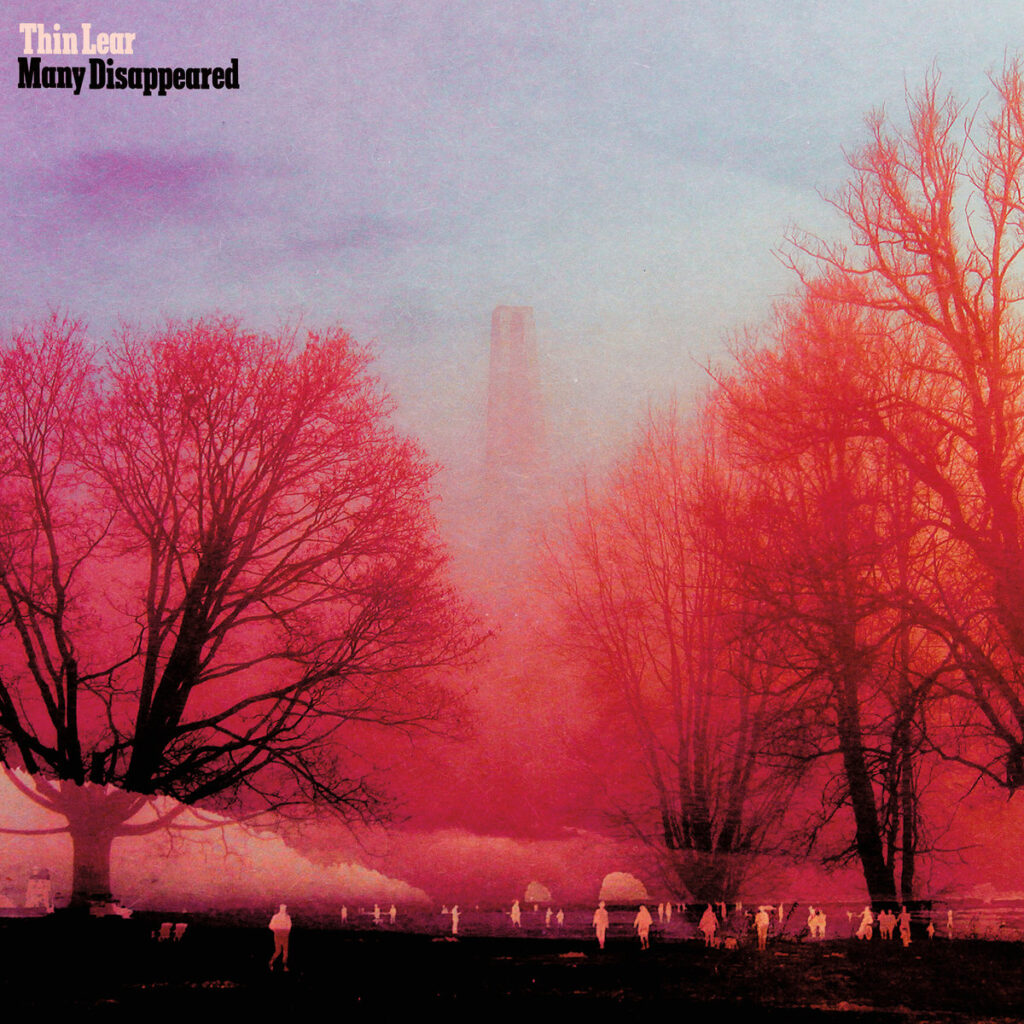
Last month, I raved over Thin Lear’s track “Witness” from the new album Many Disappeared, which dropped today (April 24th). I said it sounded like John Lennon met Van Morrison somewhere between Liverpool and Belfast (so somewhere on the Isle of Man, probably), and I chalked that incredible sound up to Matt Longo’s fantastic songwriting and GRAMMY winner Matt Ross-Spang’s expert production. You can read that write-up here.
But “Witness” was just a taste of what Longo had to offer with his sophomore album. Now, with the full record out for consumption, listeners can get a full dose of Longo’s storytelling mastery, using his words to craft sweet tunes of tragedy and melancholy. Ross-Spang, whose work has shaped the songs of Margo Price, Jason Isbell, and the great John Prine, sharpens the sound so that they form an arrowhead aiming straight for your heart. And Longo had the assistance of some of his most-admired musicians in the studio, including (but not limited to) Ken Coomer (Wilco), Will Sexton (Alexa Rose), Rick Steff (Lucero), and Dave Smith (Al Green, Kris Kristofferson, Cat Power).
Tragedy didn’t just appear in the songs of Many Disappeared: The recent death of Longo’s grandfather seeped in as he wrote them. “The world felt less interesting after he left it,” Longo says of his loss. That coupled with Longo and his partner weighing the decision of whether or not to have a child. “I felt like there was still so much I needed to fix about myself before I could have this thing I wanted, a family,” he says. Longo’s grappling with loneliness, self-isolation, and loss color the tracks on the new album: Through the personal stories he tells and those from history from which he extrapolates details, he reveals his own battles with his emotions.
“Silver Bridge”, the album’s opener, shows an example of Longo’s grief bleeding into the music: Despite him coming from Springsteen’s Jersey, there’s more of the UK apparent here (Lennon and Van, as stated, but also a bit of early Bowie). The grey clouds hang over a retelling of the tale of the titular bridge’s collapse in 1967 which killed 46 people. For months before the disaster, people reported seeing the cryptid now known as the Mothman haunting the bridge which then connected Point Pleasant, West Virginia and Kanauga, Ohio.
These days, the Mothman story acts as a tale of harbingers of death and disaster. And on “Silver Bridge”, Longo likens the Mothman to the Angel of Death and ties the story of the Silver Bridge collapse into the grief over the death of a brother. He asks if the Mothman or the Angel remembered him enough to warn him of future disasters, in order to prepare him for grief: “What’s the reason for me seeing? What’s the reason for anything? Tell me angel, if you will: Do you think of me still?”
“Harmony & Gold” is a direct ode to loneliness, with the slow tempo of the song highlighting the act of reflecting on solitude. “Ain’t it funny how your heart breaks as you recognize your mistakes / As you play back every memory of what it’s like to be alone?” Longo sings, over a tender string drone that echoes the note that plays in an empty room. “Harmony & Gold” refers to the beauty of being surrounded with love and joy, although for people who might experience loneliness more often, such beautiful things come few and far between. But when they do, their presence feels all the more precious, and when the memories of them flicker to the mind, they look all the brighter.
“Witness”, as I wrote before, synthesizes two tales: A childhood memory of Longo and his friend watching a cat die in the street, and the aforementioned death of Longo’s grandfather. Though the previous two tracks took on a slower tempo to linger on the topics of loneliness and grief, “Witness” has a somewhat quicker drive and a somewhat funky groove. This doesn’t alleviate the gravity of the song’s lyrics, but it does reflect a bit of the light that comes from not leaving the dying alone in their final moments. You can tell that the seeds of Many Disappeared planted and rooted themselves deep into the heart of this particular track.
Longo slows things back down on “A Cherished Man”, which provides vignettes of three characters. There’s Andy, who drinks himself into a stupor every night for the public’s fascination. Then there’s Annie, who pokes strangers with pins on buses for fun. Finally, there’s Charlie, who consumes corks, stones, and live animals as performance art. All of these souls do these odd things in search of connection, to which Longo says: “I see myself in all of them… They’re looking for meaningful engagement; they’re just not sure how to broker it.” In the chorus, he sings: “They say you’re only whole, you’re only true, long as someone dreams of you / And if you’re just set up to fall, you find a way to feel at all.”
On “Mattoon”, Longo uses the tale of the Mad Gasser of Mattoon, Illinois to grapple with his understanding of humanity, especially his own. In the 1940s, the Mad Gasser was a scapegoat; people only reported feeling seeing the character and feeling symptoms associated with gas exposure, leading to cases of mass hysteria throughout the town. The panic, fear of loss, alienation from neighbors, and distrust that ran rampant tore people – and nearly the whole town – apart. Longo examines his own occasional similar feelings through the lens of the event, commenting on how no one is immune from falling victim to their head or heart running wild in moments of deep pain or fear.
“The Haunt” gets even gentler, allowing Longo space to sing over a soft piano-driven track. His lyrics chronicle vivid dreams about his departed grandfather, of which he says: “I wondered if I was making it all up to make myself feel better… Without it, how do you begin to deal with the total weirdness that accompanies loss?” He refers to his fascination with the spiritual and otherworldly here, and the quiet music provides plenty of lonely room for both to flourish: “Have I gone crazy since you died? ‘Cause my heart was almost breaking from this world and all its taking. Is it only me alone and telling lies?” The following track “Heavy Dreams” continues this train of thought, pushing the instrumentation a little harder to make the colors pop a little brighter and wilder: “Brother, I can’t get control, I am learning many things I didn’t know / Brother, I can’t get control, There was weight until I chose to let it go”.
The final three tracks on the record follow the album’s theme of connecting with the spiritual in solitude. On “Buddy”, Longo sings of not wanting to lose someone, but he seems to be alone with his words. Then on “The Visit”, Longo’s voice almost takes on the tone of a younger Billy Joel; in fact, you could fool me and say that this was a lost Piano Man B-side. Longo once again taps here into the otherworldly, telling of his grandfather’s soul visiting him and not knowing how to explain the dream – or real phenomenon, perhaps – to anyone else.
On “Healing Alone”, Longo ends the record flipping the script: He sings as the dead reaching out to the lonely mourner, who seems to have trouble grappling with his pain. Over finger-picked guitar, twinkling piano, and sparse percussion, Longo admonishes but sings gently from beneath the grave: “But this is the man who showed me to stand, who would help me along and grab my hand / And healing alone is an act of hate, counting time and losing weight.” Though he compels the grieving not to wither away in solitude, he understands their pain: “Friend, can you hear the call from deep in my tomb? Oh, I see ‘em now, your sad eyes fixed to the stone.”
The meaning of the title Many Disappeared appears obvious given the context of the record: It refers to the fact that we all must deal with the huge amount of loss we face throughout our lives, if not every single day. But it also can hint at the distance from emotion that comes with loneliness, how fear can obliterate the many parts of the things that make us human, and how grief can shut out the lights in and silence a community.
But through the songs of Many Disappeared, Longo – like his characters in “A Cherished Man” hopes to build connections instead of languishing in grief. And perhaps listeners won’t feel the need to heal alone. Through the sadness, even after death or in deep pain, people need to know that no one really disappears. They come back from time to time, even in unexpected ways. Until then, all we can do is dress each other’s wounds, keep each other warm, and lend an ear to listen and a shoulder to lean on.
Longo will take Thin Lear on the road through the spring to promote Many Disappeared. Below, take a listen to the album and see when you can hear the songs live in a city near you.
Tour dates:
4/25 – Holyoke, MA (De La Luz)
4/26 – Catskill, NY (Avalon Lounge)
4/29 – New Haven, CT (Stella Blues)
5/6 – New York, NY (Night Club 101)
5/7 – Providence, RI (Getties at Fete Music Hall)
5/8 – Somerville, MA (Union Tavern)
5/9 – Portland, ME (Blue Portland Maine)
5/10 – Dover, NH (Auspicious Brew)
5/12 – Rochester, NY (Bar Bad Ending)
5/13 – Buffalo, NY (Area 54)
5/14 – Pittsburgh, PA (Poetry Lounge)
5/16 – Philadelphia, PA (Abyssinia)
5/21 – Bethlehem, PA (Apport Used Books)
5/23 – Baltimore, MD (Holy Frijoles)
5/24 – Charlottesville, VA (Superfly Brewing)
5/26 – Richmond, VA (The Camel)
5/28 – Nashville, TN (TBD)
5/29 – Memphis, TN (Lamplighter Lounge)
5/30 – Knoxville, TN (Blue Plate Special)
Written by Will Sisskind

