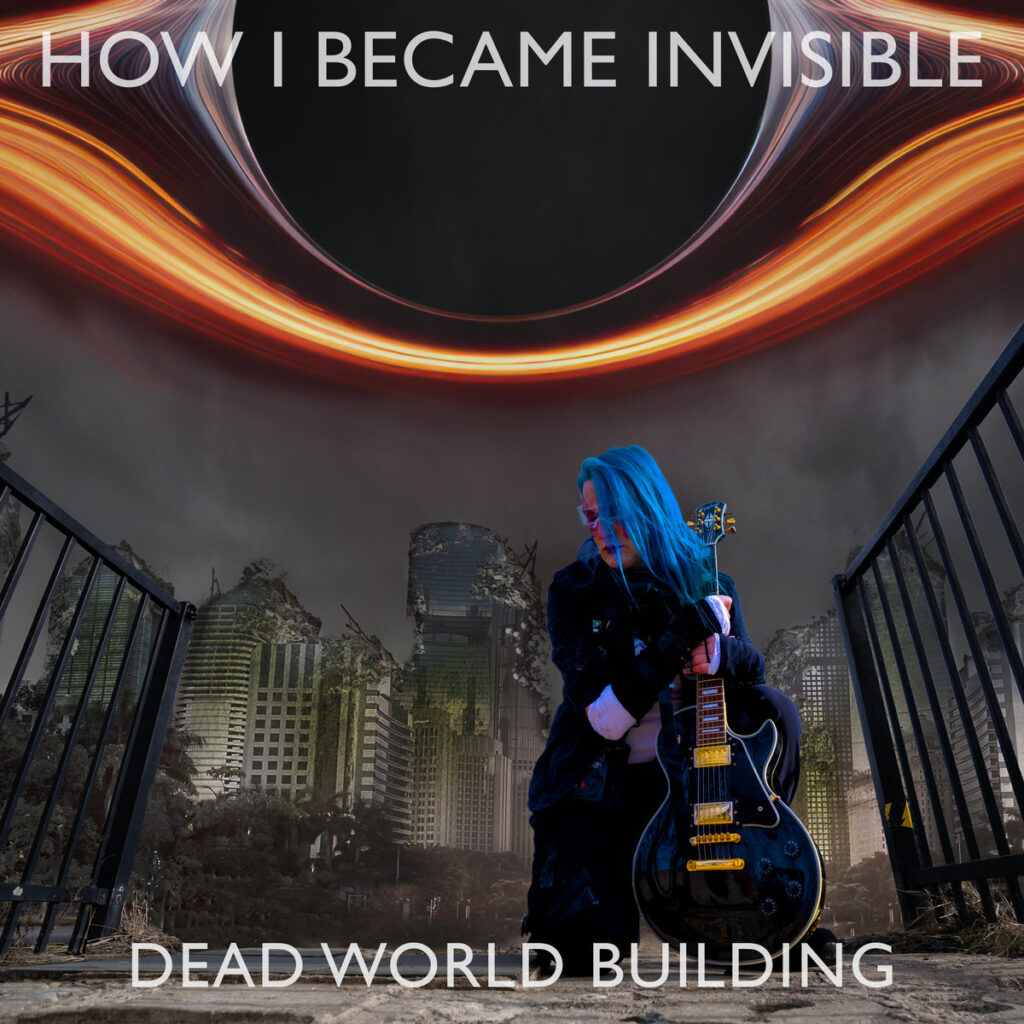
Two of our Start-Track writers took a liking to How I Became Invisible’s new album, Dead World Building. First up is Christian’s take; be on the lookout for Gimp Leg’s review of the album later this week.
The world is ending, and we have different ways of coping. While some bask in ignorance, others proceed with the banalities of life in reluctance, and others indulge in the favors and opportunities that arise. It’s all about perspective and attitude on our limited time coexisting with our cohabitants on this planet. How I Became Invisible delivers a powerful perspective on Dead World Building, with songs lamenting on the aches and toxins of the past, acknowledging the bleakness of our current and present world, and declaring strength to hold on to authenticity and community to survive the future.
“Prompt Critical” is the second track of the album, but it serves to set the attitude of the album. The term refers to an unwanted and unanticipated nuclear reaction, parallel to the negative forces that surround us, whether they be in dysphoria, calamities, or conflict. The song feels grand, and I remember feeling blown away by the powerful choruses and intricate guitar work throughout the song upon first hearing it. The mantra repeats “Take anything you want, but you won’t take the heart from me”, reminding all that despite the avaricious behavior of the forces beyond our control, there is strength in holding your values deeply and powering through this existence as your most genuine self. This is reiterated in later tracks to emphasize that, despite the awful parts of the world/self that inflict damage to the present, a firm grasp on your values will keep you strong.
Who do we blame for the current state of the world? Directing attention to the forces beyond our control, we can see a source of these imbalances in the powerful elite, as they demonize marginalized communities and hoard natural resources. “We Are (Not) OK” is a brooding track, spelling out the arduous process for the sorts of regulations that slip under the radar when priorities overshadow these needs. The song is set in a parking lot (a motif throughout the album), waiting for a prescription that has become criminalized, and these settings bestow a feeling of doom in an ever-changing environment. The world is watching, and those in need continue to feel hopeless, as these decisions are seen through the internet, where information and despair can easily spread among the affected.
“Show Me Your Teeth”, on the other hand, is a fast-paced track full of energetic frustration, spitting venom at the direction of an antagonist while lamenting the loss of childhood spaces as urban structures move in a direction that enables economic stimulation. There is a youthful punk energy throughout the track, with instrument arrangements allowing for dynamic moods in under two minutes, and I can’t help but be reminded of songs I listened to during my teenage years. And maybe that plays a big part in our discontent with the modern day: We miss the younger days, despite our differences in our relationships with the past. In order to survive and progress in our personal lives, we need to learn to let go. This is not as easy for some as memories have their own ways of replaying in seductive lighting.
“Mosh Pit in the Wawa” tackles a perspective of letting go, with the title itself an indication of the energy contained in the song. The verses have a great build, allowing focus on the vocals and lyrics during the first half before introducing a gritty energy with lead guitar riffs, which then bursts into a chorus that can incite a sing-along in a live setting. The lyrics depict strength, with the first verse describing a mentality focused on survival and resilience. The chorus explicitly declares an ending with a long-term attachment, the sort of declaration that affirms the healing nature of the decision, and a discovery of the strengths during the process. With lyrics that take aim at an antagonist – “You’re the reason I don’t think I deserve to be happy or ever will be, you’re the reason I can’t take myself seriously” – there is a clear toxicity between the narrator and the detachee, with such attachment enabling these self-destructive thought patterns. Whether this detachment is with a person, a mentality, or an environment, the separation is ultimately for the better.
“Actualization” on the other hand, takes on an attitude that feels more like closure with mentions of wasted time, empty promises, and memories left behind, all leading to “Go on, fake a smile, you’ll be waiting awhile” as a final stance upon letting go and leaving behind a piece of the narrator’s life that is no longer intended to serve any purpose.
Nostalgia plays tricks on us, especially in a time that feels hopeless. Maybe it is because we are aware that we’ve survived everything we’ve faced that some of us are more willing to anchor to the past rather than face the realities of our present day. “Dead Astronauts Pt. 2” depicts nostalgia for the narrator as a source of regret for both past and present, yearning for a misspent youth and a guilt for an inability to give more. This mentality runs concurrently with a prevailing nostalgia from those who are bogged down by the current state of the world, wishing for a seemingly simpler time. The narrating perspective declares in that case to persist with a light and advocacy for the community to thrive, before affirming the decision to not look back and maintaining a strong grip on her heart in a reiteration of “take anything you want, but you won’t take the heart from me”.
“Temporal” reminisces on the past, with dreams of childhood streets and a sense of hope compared to an empty feeling in the physical body. The chorus then brings us to the present, the current situation of people waiting for progressive changes while crumbling in despair. The bridge encourages more productive action in the development and bolstering of a supportive community that cares for each other. “There is no heaven unless all my friends are there” emphasizes the importance of supportive relationships and that this desired future is only acceptable if shared with the community, while “you can keep your various distance we’ll be just fine at our own speed” feels like an acceptance of the varied alignment with pieces of the past (or community) at their respective paces. Ultimately, the best course of action while living through different iterations of the apocalypse is through building a community, however one chooses to relate to their past.
The instrument arrangements are what make this album truly dynamic, with the presence of guitar riffs adding depth to tracks like “Prompt Critical”, “Mosh Pit in the Wawa”, and “Harley And Ivy”, the last being one of two instrumentals in the album. “Harley And Ivy” contains a poem recitation that begins with a description of your own self being your own creation, accompanied by a guiding voice advising to “try to remember who you are” in the definition of the self. As the instruments build and intensify, the narration feels more desperate with exclamations of password prompts and desperate reminders to “try to remember who you are” as a hole in the sky or a creature with fins and teeth swallows everything. The story is experienced through the instrumentation, and the desperation is felt in the final minute before declaring that our sentence is up.
With songs that are rich in guitar riffs and references to nuclear semiotics and astronomy, Dead World Building is a message of hope through acknowledgement of the present and consciousness of one’s placement in the universe. While we cannot change the past or our history with the good and bad parts of our memories, we can only progress forward with strength in community and holding on to our truest selves. “Take anything you want, but you won’t take the heart from me” is a bold way to face a world that tries to define who we are through disparity and turmoil, and that we can find strength in maintaining an unwavering authenticity.
Take a listen to Dead World Building and follow How I Became Invisible on their socials below.
Written by Christian Ang
